


Development
New Look, Same Great Sandbox
May 8th

UPDATE (March 2020): We completely removed the 2 from our application name as of Update 25. This required data folders to be renamed from “Universe Sandbox ²” to “Universe Sandbox”. If you need help with this change, please see our support page on this topic.
In Update 22.1, released in December 2018, we included a new logo (above) in the main menu of Universe Sandbox. The design is a small evolution of our last logo, but most importantly, we removed the 2 exponent. We’re no longer calling it Universe Sandbox ². Now it’s just Universe Sandbox.
We’re continuing to make this name and logo change everywhere we appear across the web. It’s a small distinction, but our reasons for changing it are significant:
1. It was confusing to say
Was it “Universe Sandbox Squared”? Or was it “Universe Sandbox Two”? Up to you!
2. It was hard to type
Do you know how to type a ² on your keyboard? No? Most of us didn’t either. And it was rare that YouTubers, journalists, or anyone else talking about Universe Sandbox would bother to find out how instead of just typing a normal “2.” We don’t blame them.
3. And most importantly, Universe Sandbox is here to stay
Sometimes people ask us when Universe Sandbox 3 is coming. Naming confusion aside, this is their question: when is a new version of Universe Sandbox going to be made? Our answer is that we have no plans for an entirely new version. There will be many more updates with new features, content, improvements, and bug fixes, but these are all planned for the current version of Universe Sandbox. Our roadmap stretches far into the future; we hope to continue to build, maintain, and research new technologies for Universe Sandbox so we can keep development going for a long time to come.
Universe Sandbox & Universe Sandbox Legacy
If you want to make your head spin, you can trace the history of the slight name changes that have been going on since the very first version of Universe Sandbox over a decade ago. (Here’s a sample: What we’re now calling Universe Sandbox was Universe Sandbox ², but when Universe Sandbox Legacy was called Universe Sandbox v2, before it was just Universe Sandbox, the now-called Universe Sandbox was actually referred to as Universe Sandbox 3, before being changed to Universe Sandbox ². Yep.)
But there are really only two things you need to know: There’s Universe Sandbox Legacy, which is the original Steam version released in 2011. And then there’s Universe Sandbox, which is the latest version now available on Steam Early Access, aka the version we hope you’ll be playing for years to come.
Universe Sandbox ² is dead. Long live Universe Sandbox!
Join the official Universe Sandbox Discord

Surface Grids & Lasers | Dev Update #2
Apr 26th
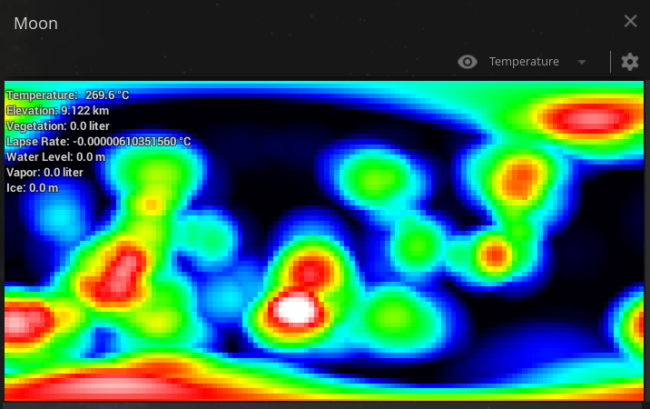
Image: A work-in-progress view of temperature data for the Moon’s surface during Bombardment of the Moon simulation
Here’s our round two update on the development status of Surface Grids and Lasers.
A primer on Surface Grids for anyone not familiar:
It’s a feature we’re developing for Universe Sandbox that makes it possible to simulate values locally across the surface of an object. In effect, it allows for more detailed and accurate surface simulation and more dynamic and interactive surface visuals. It also makes it possible to add tools like the laser, which is essentially just a fun way of heating up localized areas of a surface.
If you haven’t seen it yet, check out our blog post from a couple of weeks ago (we’ll call that Dev Update #1) where we talk about our decision to delay Surface Grids in favor of a rewrite that will better meet our Quality Standards for Awesome Features.
Keep in mind this is a development log for a work-in-progress feature. Anything discussed or shown may not be representative of the final release state of Surface Grids.
Getting Up to Speed
We’re happy with the progress that we’ve made so far on the new Surface Grids. We haven’t encountered any significant roadblocks (knock on wood) and the results we’ve seen are very promising.
Feature development in the beginning can be very exciting, because it can seem relatively quick to set up a framework, especially with a feature like this, where it’s a rewrite of a model we put a lot of work into. Early technical implementations can also give us a good sense of what’s to come and what is possible. At the same time, they can be a little less accessible from an outside perspective because they don’t have any of the polish and pizazz of a complete feature. At this point progress can also be a bit misleading, because often times the longest and most challenging part of development comes later, when we’re tweaking, polishing, finding and fixing bugs, and making sure all the complexities of the fully fleshed out model play nicely with each other and the rest of the simulation.
But let’s not get too ahead of ourselves — here’s a look at the progress we’ve made so far.
Zoom, Enhance!
As mentioned in our last post, concerns about performance with our old model played a significant part in our decision to do a rewrite. Performance relates directly to the resolution of the model: a higher resolution means more computations and slower performance. But the resolution of the model determines just how detailed the data and visuals can be, so a lower resolution model makes it that much less interesting.
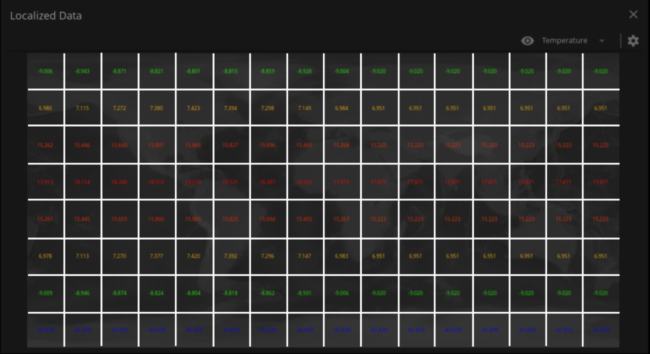
The old model was scalable and the image below represents a fairly low resolution for the model, but it was also the baseline that we were working with because of performance concerns. In other words, we could run it at a higher resolution, but performance quickly took a hit once there were a bunch of objects in a simulation all running Surface Grids. Turning down the resolution helped, but not enough.
Compare that with the resolution of this new model, where each pixel is equivalent to a grid square in the above image.
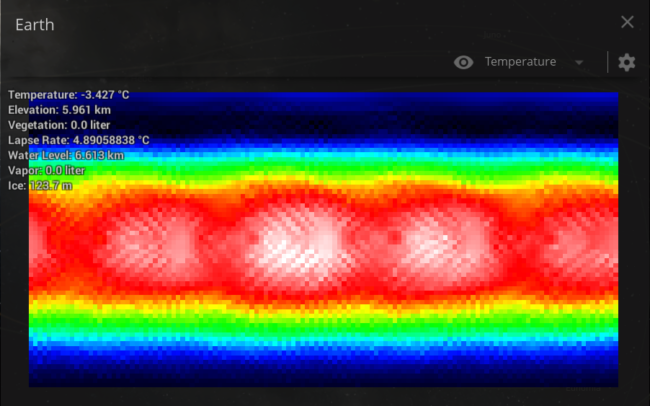
See the difference? Generally speaking, the new version of Grids is at least 100 times faster than the old version. Yes, that is much, much faster. And it makes us very, very happy.
This clip shows a data map of Earth’s temperature as it becomes tidally locked. And, importantly, there are also 99 other Earths in this simulation all running their own equally high-res Surface Grids model.

A big thank you to our lead developer, Chris, for creating this new, powerhouse version of Surface Grids.
Water World
There’s another new feature in this model that we didn’t have before: simulated water flow.
Currently water flow is affected by elevation, which in turn can be affected by impacts. Our wish-list for the future of Surface Grids includes elevation-editing tools, but right now we’re not expecting those anytime soon (including the first release version).
This clip briefly shows typical water flow on Earth (currently the model runs even while paused) before it’s affected by an impact with the Moon.

Water flow is a pretty experimental aspect of the model right now, so it’s especially likely this will change significantly as we continue development.
Getting the Data Right
We’d consider the whole of Surface Grids a wash if the data wasn’t based on science. But good news: it sure is based on science.
Jenn, Universe Sandbox astrophysicist and developer, has been busy getting all the data and numbers right in the technical framework. Sometimes a model will produce interesting and compelling results, but if the numbers aren’t based in science and the results aren’t showing what we’d expect to see for an accurate (though simplified) model, then it doesn’t meet our goals for a Universe Sandbox feature.
Building an accurate, generalized model for this is no easy task. It has to handle a range of materials (silicate, water, etc.) at different phases (solid, liquid, gas), all determined by other factors like elevation and temperature; each point has to interact with the rest of the grid, the rest of the Universe Sandbox simulation, and any user input; it has to run in real time; and in a normal state, it has to produce something that looks like the Earth or Mars we’re familiar with. Fortunately, this is well tread territory at this point, as Jenn solved a lot of these problems with the last model of Surface Grids.
What’s Next for Grids
We feel very good about the progress we’ve made so far and we plan to keep moving forward at this pace. We’ll continue with the technical implementation while also adding and double-checking the scientific layers of the model.
You’ll notice in the tidal-locking clip above that we only showed the data map, not the actual planet itself, as its local temperature shifted. That’s because there’s not much to see yet (compare to the visual state of the last model as seen in the last post). We love data, but we also love planet surfaces that look pretty and glow. The surface visuals are an important part of Surface Grids, and now that we have the technical framework laid out, it’s time to make it look good. Our graphics developer, Georg, is just getting started on these visual aspects, which are also based on his previous work on the old Grids model. We look forward to sharing his work in a future Grids posts!
Bringing the Magic of Universe Sandbox to Magic Leap
Apr 16th
Indie Creator Program
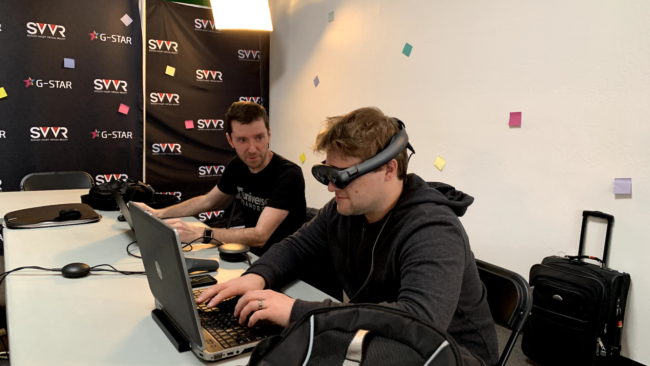
The news is out, we got a grant to develop Universe Sandbox for Magic Leap! Out of the 6,500 applicants that applied for Magic Leap’s Independent Creator Program, we were one of the lucky 30 that were accepted. We’re excited to join the company of other great indie developers and excited to bring the Universe Sandbox experience to Magic Leap.
If you’re not familiar, Magic Leap creates mixed-reality (MR) technology. Like VR, MR utilizes a headset and a motion-tracked controller for interaction. But unlike VR, the real world doesn’t disappear when you put on the Magic Leap headset. MR creates a map of the physical world around you and then superimposes digital images over it, bringing objects to life by making them appear like they are right there in front of you.
And with the mapping and object detection, the real world can interact with the digital world, allowing you to do things like smash planets against your wall.
Bootcamp
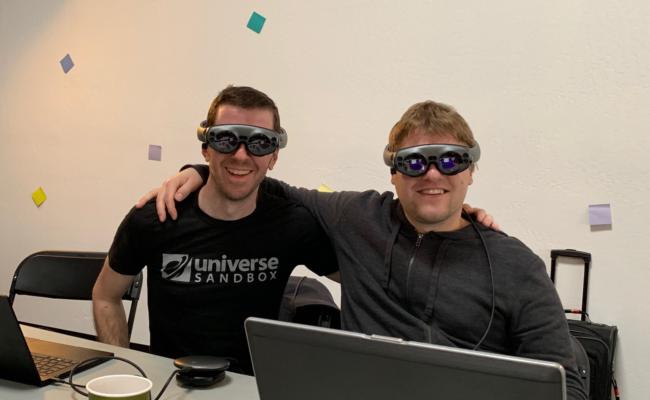
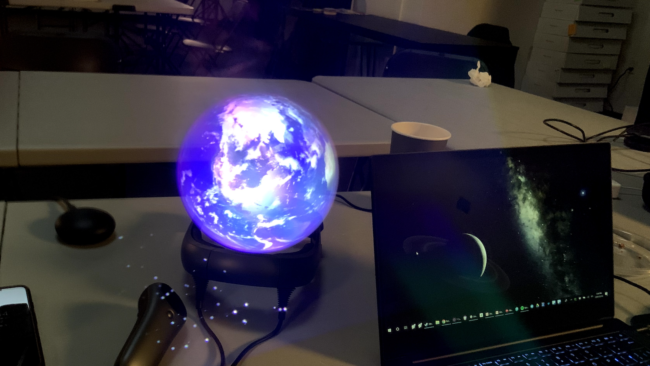
The very first step of development. Viewing Earth in Universe Sandbox through Magic Leap.
In February, Dan (Universe Sandbox creator & director) and Dave (Universe Sandbox mobile developer) went to California to attend the Magic Leap Creator Bootcamp. The Bootcamp was a crash-course in Magic Leap development, with discussions about the hardware, technical considerations, best design practices, and everything else creators like us need to know to make our magic happen.
It was an inspiring few days and a great opportunity for us to see what others are working on and what is possible for Universe Sandbox. We received some quality feedback on our plans as well as some exciting ideas for new directions.
Improving Universe Sandbox on Every Platform
Developing Universe Sandbox for Magic Leap is without a doubt exciting. But we don’t think about this development work as existing in a vacuum. While we continue to develop for desktop, we’re completely rewriting our VR interface, we’re polishing and optimizing for mobile, and we’ve now begun this work for Magic Leap. Further in the future, we’d like to do console versions, too. A key part of our vision for all of this is that the Universe Sandbox experience is never watered down. We want to make it possible to do the same things with Universe Sandbox in VR and on your phone that you already do on your desktop.
Of course, different platforms have different strengths and weaknesses; our design decisions are affected by these considerations for different hardware, different input, etc. But we can still aim for the power and flexibility that exists in the desktop simulation and interface.
Some of the design problems we face with Magic Leap will require developing solutions that improve all platforms. We expect the work we do on the interface will have a lot of significance for both the VR version and the mobile version that we are working on. And the performance optimizations we make while getting Universe Sandbox running on the Magic Leap headset will certainly have a ripple effect and improve performance on every other platform.
We look forward to sharing more about this journey as we continue development for Magic Leap!
What’s Next for Universe Sandbox | Spring 2019
Apr 10th
Delayed Gratification
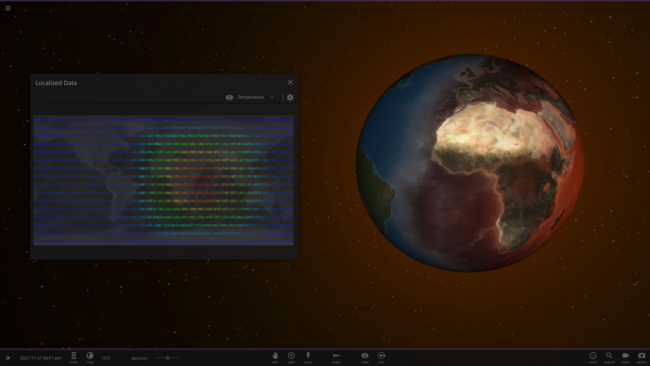
We know many of you have been patiently waiting for two of our next big features, Surface Grids & Lasers. We believe these features will be an awesome addition to the core Universe Sandbox simulation and experience, and we know from your excitement that you agree.
Not familiar with Surface Grids? It’s a feature we’re developing for Universe Sandbox that makes it possible to simulate values locally across the surface of an object. In effect, it allows for more detailed and accurate surface simulation and more dynamic and interactive surface visuals. It also makes possible tools like the laser, which is essentially just a fun way of heating up localized areas of a surface.
Short Version
If you’re a fan of treating bad news like a bandaid that needs to be ripped off, here’s the short version: We chose to further delay the release of Surface Grids & Lasers because our implementation was not meeting our expectations. We are now applying our work to a completely new approach that we think will be well worth the wait. We hope to have it ready this summer. Thank you for your patience!
And in the meantime, we hope to release some new simulation features: improved physics and new galaxies. Read more about these below.
Long Version
And if you’re curious, here’s the longer version: Last month we sat down for a team meeting on the status of Surface Grids and Lasers and had to make a difficult decision. The features weren’t quite living up to our expectations and standards. While we were continuing to make progress on development, we were also continually running into problems and were pushing the technical limitations of the system we had implemented, all with diminishing returns. We could either continue to work through all of the issues that remained and end up with something that met most of our high-level design goals but fell short on performance, or we could take everything we had learned and reimplement it in an entirely new system that would meet even more of our goals, be exponentially faster, bypass some of the issues we were trying to solve, and have much more room for future expansion. That makes it sound like a clear choice, but there were a couple of drawbacks: there were some technical compromises with this proposed new system, and pursuing it meant that we’d have to further delay the release of these features, something that we knew both we and our fans would not prefer. But after more discussion, we decided we didn’t want to compromise the quality of these features — let’s delay a bit, work on this better version, and release something that we’re very proud of. Please know that we are committed to new features and improvements and to the long-term future of Universe Sandbox development. We’re even expanding our team again — come join us as a Graphics Developer or Spaceship Physics Developer!
We can’t give a release date yet for Surface Grids & Lasers, but our plan moving forward is to provide an update every two weeks on their development. Below is a preview of what’s to come, showing a tidally-locked Earth close to the Sun where the back side freezes over and the near side becomes molten. And wait for the laser at the end!
Please note: the following image and the image at the top of this post are from the previous implementation of Surface Grids. We hope to go above and beyond what can be seen here for our new implementation, but the feature is subject to change and these may not be representative of its final state.

Improved Physics & New Galaxies
While we all wait as patiently as possible for Surface Grids and Lasers, we hope to deliver on two other features that have also been a long time coming: 1) a new, faster, and more stable physics system and 2) brand new galaxies.
Faster & More Stable Physics
The new physics system actually followed a similar development story as the one above about Surface Grids. After a long time spent working on the new system, the bulk of it was finished but stubborn issues stood in the way of its release, and new ones seemed to pop up every week. Eventually, we decided to cut our losses and run with a brand new system that was suddenly feasible thanks to some new Unity technology. Turns out this was a great move — we already have an experimental version of this new physics system available in Update 22.2 (learn more about trying it out). We hope to have the remaining kinks worked out soon so we can release it officially and get to work on some exciting new physics features again.
Brand New Galaxies
We also have already made great progress on a rewrite of galaxies, finally showing them the love that they have long deserved. These new galaxies will be much more varied, more interactive, and more accurate in simulation and appearance. The GIFs below do not show the latest visual changes, but they do a great job of showing how much more dynamic these galaxies are.
They will allow real-time editing of their properties, just like with any other object in the simulation:

And here you can see a series of procedurally generated galaxies added to a simulation:

We’re super proud of how galaxies have been shaping up so far. They’re impressive technically, scientifically accurate, fun to play with, and they’re looking pretty good, too. That checks all of our boxes for a quality Universe Sandbox feature. We look forward to sharing them in the future.
Revamped Vapor & Engine Experiments | Update 22.2
Apr 10th
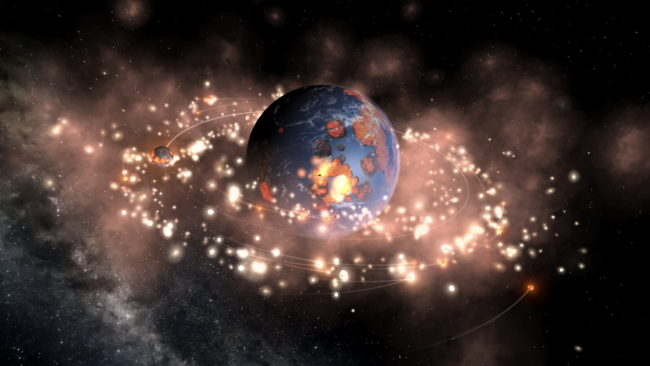
April 18: 22.2.1 & 22.2.2 address a Mac-specific issue that caused crashes while using the Add panel. Known Mac issue: loading “Solar System Planets, Moons, and Large Objects” simulation sometimes results in a crash.
Run Steam to download Update 22.2, or buy Universe Sandbox via our website or the Steam Store.
This update adds improved vaporization effects that are more accurate and colorful. It also introduces an experimental version of our new physics system that makes gravity simulation faster, more stable, and more accurate. We’d love it if you tried it out and helped us test it!
Home > Try New Physics
Please remember this system is still experimental. If you experience any problems, let us know! You can report any issues on our forums (local forum | Steam forum) or via Home > Send Feedback.
There are also dozens of smaller improvements and fixes. Here are some of the highlights:
- Added Fahrenheit as a temperature unit
- Added Filipino to available languages
- Improved Search in Open panel
- Trails & orbits work on older hardware again
- Object lighting on Linux works again
- New simulation with all planets, moons, and large Solar System objects
Check out a full list of What’s New in Update 22.2
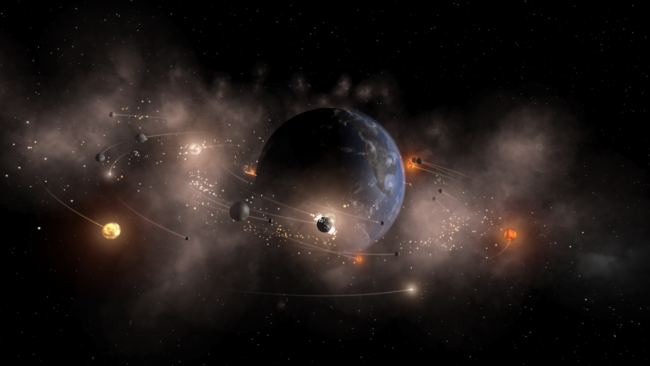
We’re excited for the upcoming official release of this new physics system so that everyone can enjoy the improvements to performance and accuracy. We’re also working on brand new galaxies and, while we had a setback with Surface Grids & Lasers, we are now making good progress again. Learn more about our progress on these features
We’re hiring a Graphics Developer! Learn more and apply
We’re hiring a Spaceship Physics Developer! Learn more and apply
2018 Retrospective
Jan 7th
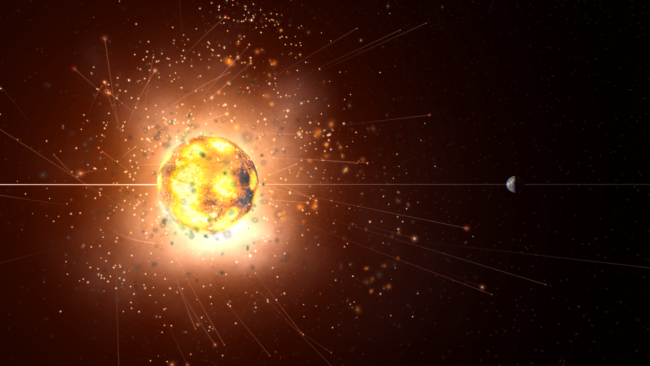
Happy New Year!
Before we take a look at what’s coming to Universe Sandbox this year, let’s take a look back at our achievements in 2018, by the numbers:
1
new team member: welcome, Jules, our new sound designer!
2
the # that was dropped from the logo.
That’s right, now it’s just Universe Sandbox. We’ll have more to say about this soon!

8
# of significant updates to Universe Sandbox.
- They Put a Car in Space, We Upgraded Our Engine | Update 20.5 | March 7, 2018
- More Super Supernovae | Update 20.6 | March 15, 2018
- This Hyperbolic Update Will Change Your Life | Update 20.7 | May 24, 2018
- 20 Earth Languages & 12 Jovian Moons | Update 21 | July 19, 2018
- Windows Mixed Reality Support | Update 21.2 | August 02, 2018
- The Extremes of Our Solar System | Update 21.3 | October 04, 2018
- The Universe Just Got Bigger: Steam Workshop Support | Update 22 | November 15, 2018
- Far Out | Update 22.1 | December 20, 2018
12
# of Universe Sandbox team members that fit into one house in Spain for a week.

21
# of new simulations.
- 2 Parker Solar Probe sims
- 2 Tesla Roadster sims
- 2 sims of Jupiter’s newly discovered moons
- New Horizons Ultima Thule Encounter in 2019
- 2018 VG18: The Most Distant Object in the Solar System
- 2015 TG387: A Goblin at the Edge of the Solar System
- Voyagers 1 & 2 Start 2019 Outside the Solar System
- Ultimate Engineered System
- Solar System with No Sun
- Kepler 10
- Kepler 47 Binary System
- Alpha Centauri Triple System
- Saturn & Earth
- Retrograde Asteroid 2015 BZ509
- Interstellar Object with a Hyperbolic Trajectory
- Solar System with Betelgeuse instead of the Sun
- Conservation of Momentum lesson
- Gravitational Force lesson
This just includes the simulations that we added, though. Scroll down for a much larger number of simulations that our community has shared on Workshop!

22
# of languages now supported in Universe Sandbox.

26
# of pages of release notes for Universe Sandbox updates in 2018.
Check out What’s New.
325
# of bugs fixed.
You know what they say, fixing a bug a day keeps the QA away. Just kidding, we can’t — and don’t want to — stop our awesome QA, Mat, from hunting down bugs in Universe Sandbox.
Not all of these bug fixes were notable for releases, as there are many bugs that are discovered and fixed while we’re still doing behind-the-scenes work with improving Universe Sandbox. We look forward to squashing hundreds more this year!
479
Highest # of concurrent users in Universe Sandbox in 2018 (happened on the week of August 6).
This is the fifth highest of all time for us.
1,114
# of positive Steam reviews of Universe Sandbox written in 2018.
All this love for Universe Sandbox really warms our cold, spaceborne hearts. <3

2,420
# of simulations shared on Steam Workshop.
That means there are literally thousands of simulations featuring alien planets and systems, recently discovered exoplanets, confounding scientific phenomena, worlds from movies, books, and other video games, and of course bizarre bugs (or are they features?), created by you, the community, now shared on Steam Workshop. We look forward to seeing this treasure trove continue to grow.
7,160
# of copies of Universe Sandbox donated for charity.
This year we donated copies to StackUp for distribution to military personnel, donated proceeds to the National Center for Science Education, provided copies to schools and educational organizations, and donated copies for various fundraisers for people doing awesome things, like all the folks at CosmoQuest.
12,694
# of objects added to the Universe Sandbox database.
That’s 11,973 new Solar System objects, 387 new exoplanets, 310 new stars, 21 new moons, 2 new human-scale objects, and 1 new galaxy.
95,736
# of messages sent on Slack.
We’re a remote team, so other than some video chats and comments on GitHub, all of our conversations happen on Slack. It’s what makes our collaboration on Universe Sandbox possible!
>100,000
# of copies sold on Steam and other platforms.
Or, on average, one copy sold every five minutes — comfortably keeping pace with last year!
4,506,463
# of views of Markiplier’s two recent videos featuring Universe Sandbox.
These were the most watched Universe Sandbox videos on YouTube this year. And this brings the total number of views of Markiplier’s Universe Sandbox videos to… 35,522,196. Granted, 24 million of those views are on the so-catchy-you-really-will-regret-being-reminded-of-it Space is Cool remix, but we’ll take some credit for providing a bit of inspiration and a nice backdrop for Markiplier’s auto-tuned cries of love for space. Many thanks to Markiplier for helping spread the word!
Can you BLOW UP a BLACK HOLE: https://youtu.be/LW6S74J4kA8
1000 WAYS to DESTROY EARTH: https://youtu.be/4FEdjWW98QI
>6,000,000
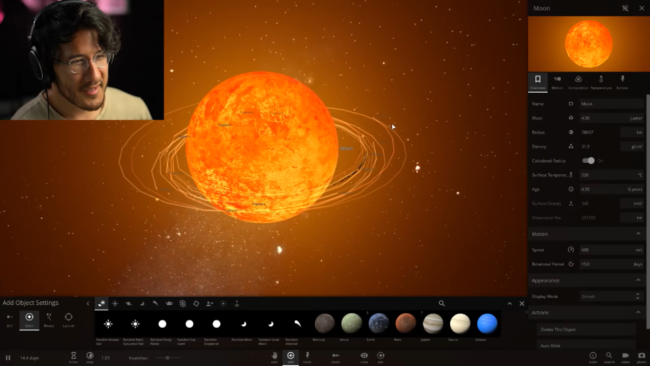
# of supernovae in Universe Sandbox.
According to our analytics, y’all have exploded more than 6 million stars. Needless to say, that’s an accomplishment.

What’s Next?
Our big features this year were Localization (support for other languages) and Steam Workshop. A lot of time and effort went into these features, and we think they’re a pretty big deal — Localization opens up Universe Sandbox for the first time to people all over the world, and support for Workshop has made it super easy to check out an ever increasing catalogue of simulations made by people pushing the limits of Universe Sandbox.
But we also recognize that these features did not change any aspects of the simulation itself. And the simulation is the heart of Universe Sandbox. While we made a number of some smaller improvements and fixes related to the simulation, we unfortunately ran into continual issues with two big updates that we had hoped to get out this year — Surface Grids / Lasers and a physics rewrite. Surface Grids will allow for more detailed surface simulation, including localized temperatures, which makes possible things like heating from lasers. The physics rewrite should greatly increase physics performance and pave the way for additional physics-related features, like megastructures.
We hope to have more news about Surface Grids soon, along with some insight into some of the obstacles we’ve faced with its development. We also continue to work on other projects like new star audio, a new tutorial system, a VR interface overhaul, new galaxies, a mobile version, and continual improvements to the overall experience.
We thank all of you for your continued support of Universe Sandbox! This year we remain committed to improving Universe Sandbox as we develop and plan new features, upgrades, and fixes for 2019 and the years to come.
– The Universe Sandbox Team
Dan, Chris, Georg, Alexander, Jenn, Jonathan, Dave, Rappo, Mat, Jacob, Erika, Jules, and Jared
New Year, New Limits of our Solar System for New Horizons
Dec 31st
Happy New Year!
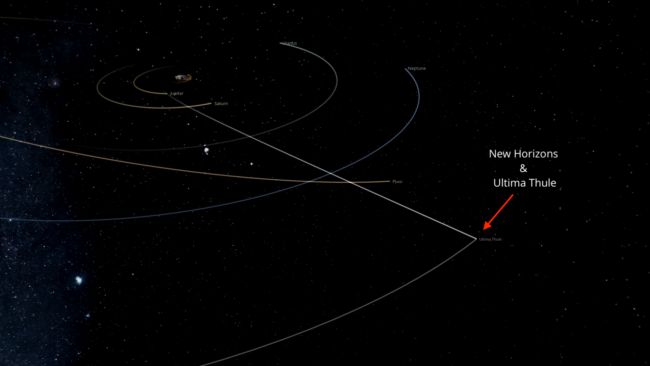
While we celebrate one more trip of our beautiful planet around the Sun, the spacecraft New Horizons sets a record for traveling to the most distant object in our Solar System ever visited, 2014 MU69, nicknamed “Ultima Thule.” This object is currently 1 billion miles beyond Pluto, or more than 43 AU from the Sun, which means it is more than 43 times the distance between the Earth and the Sun. New Horizons is expected to make its closest approach to Ultima Thule shortly after midnight EST January 1, 2019.
Check out the flyby in Universe Sandbox:
Home > Open > New Horizons Ultima Thule Encounter in 2019
New Limits for New Horizons
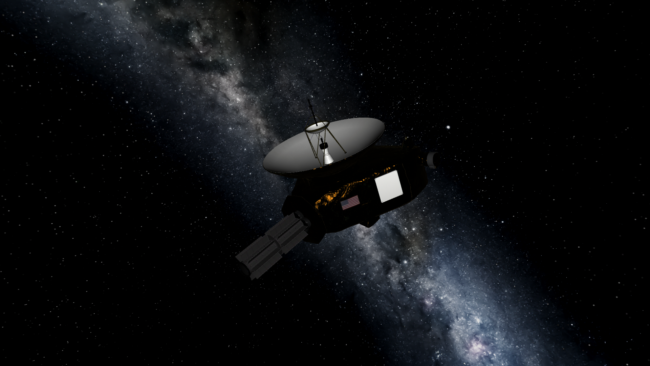
After the record-setting 2015 flyby of Pluto and its moons, the New Horizons spacecraft continued its journey through the outer reaches of the Solar System. In that same year, NASA selected a new target for New Horizons to observe: a Kuiper Belt object discovered by the Hubble Space Telescope the year earlier, known as 2014 MU69. Unofficially named Ultima Thule in 2018 based on a public vote, this object will be the most distant ever visited by a human spacecraft (breaking the record New Horizons itself set when it flew past Pluto).
The team says it hopes to set a new target for New Horizons once it passes Ultima Thule. With plenty of remaining fuel and equipment and instruments that remain in good condition, New Horizons is all set to head toward another distant object in the Kuiper Belt, arriving sometime in the 2020s, the team said.
Simulation Limitations
Simulations in Universe Sandbox are not perfect representations of reality. Rather, they’re meant to provide a visual — and as a result, a more intuitive understanding — of what is happening farther away than we can see or even imagine. With that in mind, there are a couple of limitations currently in this simulation:
1 – Trajectory
The trajectory shown is according to the NASA Jet Propulsion Laboratory’s orbital predictions as of September 2018. Additional maneuvering with thruster burns is expected, which would change the final trajectory. New Horizons will make an approach much closer than is represented in the simulation: it should pass about 3,500 km from 2014 MU69. Once actual trajectories have been recorded, we will update the simulation.
2 – Shape
Previous observations show that 2014 MU69 is likely not spherical, but rather cigar-shaped. Researchers suspect that Ultima Thule may even be two separate bodies that are either orbiting very closely as a binary or actually touching each other, which is called a contact binary. We should know more once New Horizons sends back data from its flyby! Right now, Ultima Thule is represented in Universe Sandbox as just a single, spherical body.
Other Far Out Objects
Update 22.1 of Universe Sandbox added three other simulations that feature very distant objects in our Solar System.
1 – Voyagers 1 & 2 in Interstellar Space
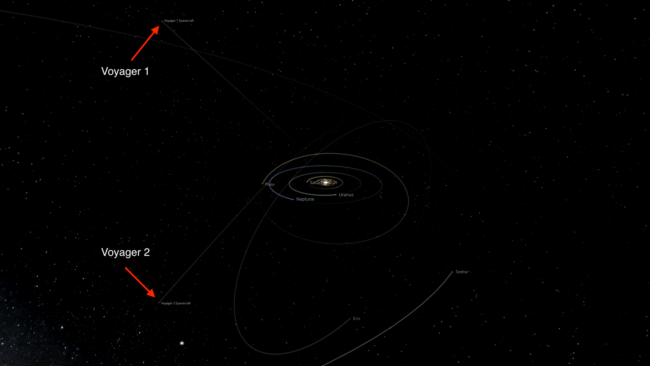
In November 2018, more than 40 years after its launch, and long since trips past Jupiter, Saturn, Uranus, and Neptune, the Voyager 2 probe entered interstellar space. It now joins its twin, Voyager 1, in exploring beyond our Solar System. They are expected to continue to send back data until they run out of power in 2025.
Home > Open > Voyagers 1 & 2 Start 2019 Outside the Solar System
2 – 2018 VG18, “Farout”
On December 17, 2018, astronomers announced the discovery of the most distant known object in the Solar System, 2018 VG18. Nicknamed “Farout” (can you guess why they chose that name?), the trans-Neptunian object is currently around 120 AU (1 AU is the distance from the Sun to the Earth) from the Sun. While this object is the most distant ever observed, there are other known objects, like Sedna and the Goblin (see below), that have orbits that take them much farther from the Sun.
Farout’s orbit shown in this simulation is a preliminary estimate; its distance means it will take years of observation before its precise orbit is known.
Home > Open > 2018 VG18: The Most Distant Object in the Solar System
3 – 2015 TG387, “The Goblin”
On October 1, 2018, astronomers announced the discovery of the trans-Neptunian object 2015 TG387, which they nicknamed “The Goblin.” It was observed at about 80 AU from the Sun, but because of its extremely elongated orbit, it likely travels to a distance of more than 2300 AU at its farthest point.
Home > Open > 2015 TG387: A Goblin at the Edge of the Solar System
Far Out | Update 22.1
Dec 20th
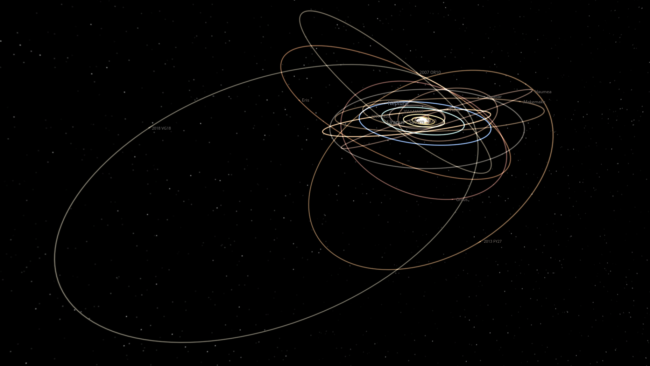 The orbit stretching to the bottom left is 2018 VG18, the most distant known object in the Solar System. The orbit shown here is a preliminary estimate; more accurate data will be available only after years of observation.
Run Steam to download Update 22.1, or buy Universe Sandbox via our website or the Steam Store.
This is a small update that adds a few new sims in addition to dozens of improvements and bug fixes.
Check out these sims featuring incredibly distant Solar System objects, including the recently announced 2018 VG18, nicknamed “Farout”:
Home > Open > 2018 VG18: The Most Distant Object in the Solar System
Home > Open > 2015 TG387: A Goblin at the Edge of the Solar System
Home > Open > Voyagers 1 & 2 Start 2019 Outside the Solar System
Don’t forget to check out New Horizons’ upcoming flyby of the most distant Solar System object ever visited, scheduled for January 1, 2019:
Home > Open > New Horizons Ultima Thule Encounter in 2019
And here are some highlights from the long list of improvements and fixes:
- Smarter autosaves
- Improvements & fixes for opening, saving, & sharing sims
- Better randomized properties for randomly created objects
- Fixes for issues with frozen fragments & missing orbit previews
- Restored visuals for explosions & fragments
Happy holidays! Stay tuned after the New Year for a recap of this past year and a look at what we’ve got in store for 2019.
Check out a full list of What’s New in Update 22.1
Please report any issues on our forums (local forum | Steam forum) or in-game via Home > Send Feedback.
Follow @universesandbox
The Universe Just Got Bigger: Steam Workshop Support | Update 22
Nov 15th
Run Steam to download Update 22, or buy Universe Sandbox ² via our website or the Steam Store.
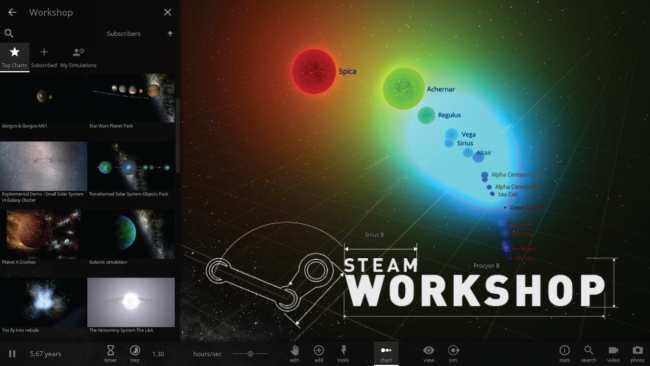
Create and share your simulations and explore the creativity of the Universe Sandbox community!
Home > Workshop
Home > Save > Share to Steam Workshop
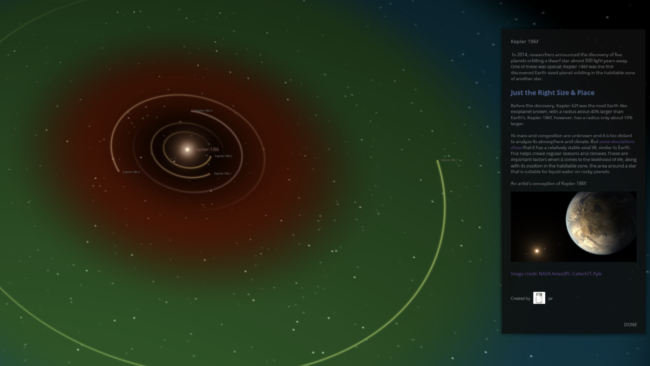
Use the new custom sim descriptions to detail the lore of your sci-fi worlds. Or discuss the reality behind the scientific phenomena in your simulations.
This update also includes changes to the interface with new tools for manipulating Property values plus styling improvements throughout. There’s a new autosave system to prevent accidental loss of work, and as always, there are lots of smaller improvements and bug fixes. See the full list of What’s New
Please report any issues on our forums (local forum | Steam forum) or in-game via Home > Send Feedback.
Notes:
1) Workshop only supports simulations at this time. In the future, we hope to add support for custom textures and models.
2) Workshop is only available for the Steam version of Universe Sandbox. We’d love to use our own system in the future for sharing and exploring community sims on any platform, but we don’t have a timeline for this yet.
3) As of this update, Universe Sandbox no longer supports DirectX 9 or 32-bit operating systems. Users can run the last compatible version by selecting “*directx9-32bit” via Steam Betas (learn how). For more information on our decision to end support for DirectX 9 & 32-bit systems, please see our announcement from earlier this year.
The Extremes of Our Solar System | Update 21.3
Oct 4th
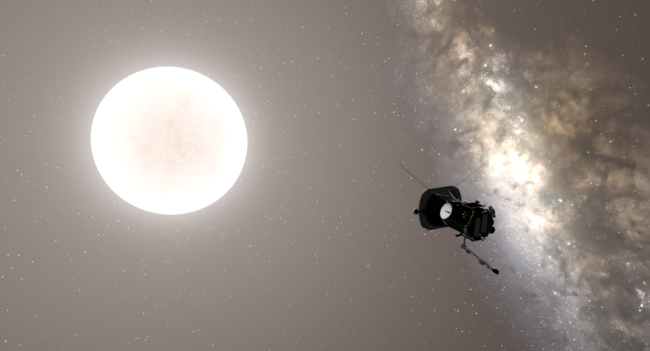
Run Steam to download Update 21.3, or buy Universe Sandbox ² via our website or the Steam Store.
This is a small update that features a new Parker Solar Probe model and new simulations exploring extremes in our Solar System:
Skim past the Sun with the Parker Solar Probe. The probe was launched in August and now has 24 trips around the Sun planned for its 7-year mission. Each year its orbit will take it closer to the Sun as its instruments capture data that will help us better understand our resident star. Its closest approach will bring it within 8.86 solar radii, or 3.83 million miles, of the Sun’s surface, more than 7 times closer than any previous spacecraft.
Home > Open > The Parker Solar Probe
Home > Open > The Parker Solar Probe’s Closest Approach to the Sun
Add > Objects > Parker Solar Probe
And ride along with New Horizons as it continues through the far reaches of our Solar System past Ultima Thule. After the probe’s flyby of Pluto and its moons in 2015, NASA selected the Kuiper Belt object Ultima Thule as its next target. When New Horizons makes its closest approach on January 1, 2019, Ultima Thule will become the farthest object ever visited by a spacecraft.
Home > Open > New Horizons Ultima Thule Encounter in 2019
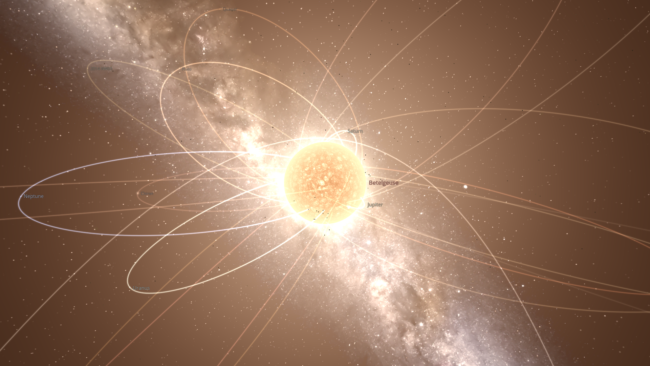
Plus: what if our Sun was replaced with one of the largest known stars in the universe, the red supergiant Betelgeuse?
Home > Open > Solar System with Betelgeuse Instead of the Sun
This update also includes an improvement to the accuracy of positions for moons and other objects in the Solar System Now & Real Time simulation, plus a few other smaller improvements and bug fixes.
Check out a full list of What’s New in Update 21.3
Please report any issues on our forums (local forum | Steam forum) or in-game via Home > Send Feedback.