


Universe Sandbox Roadmap: 2026 & Beyond

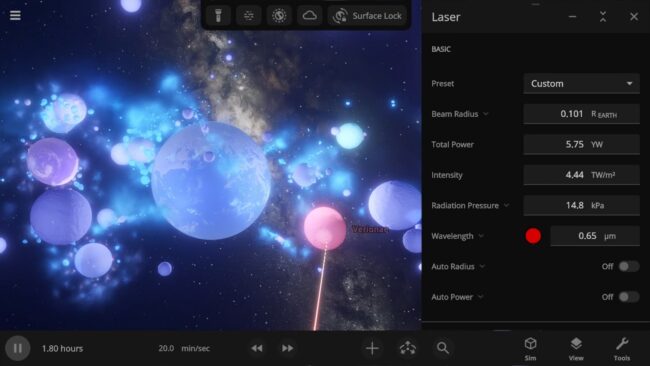
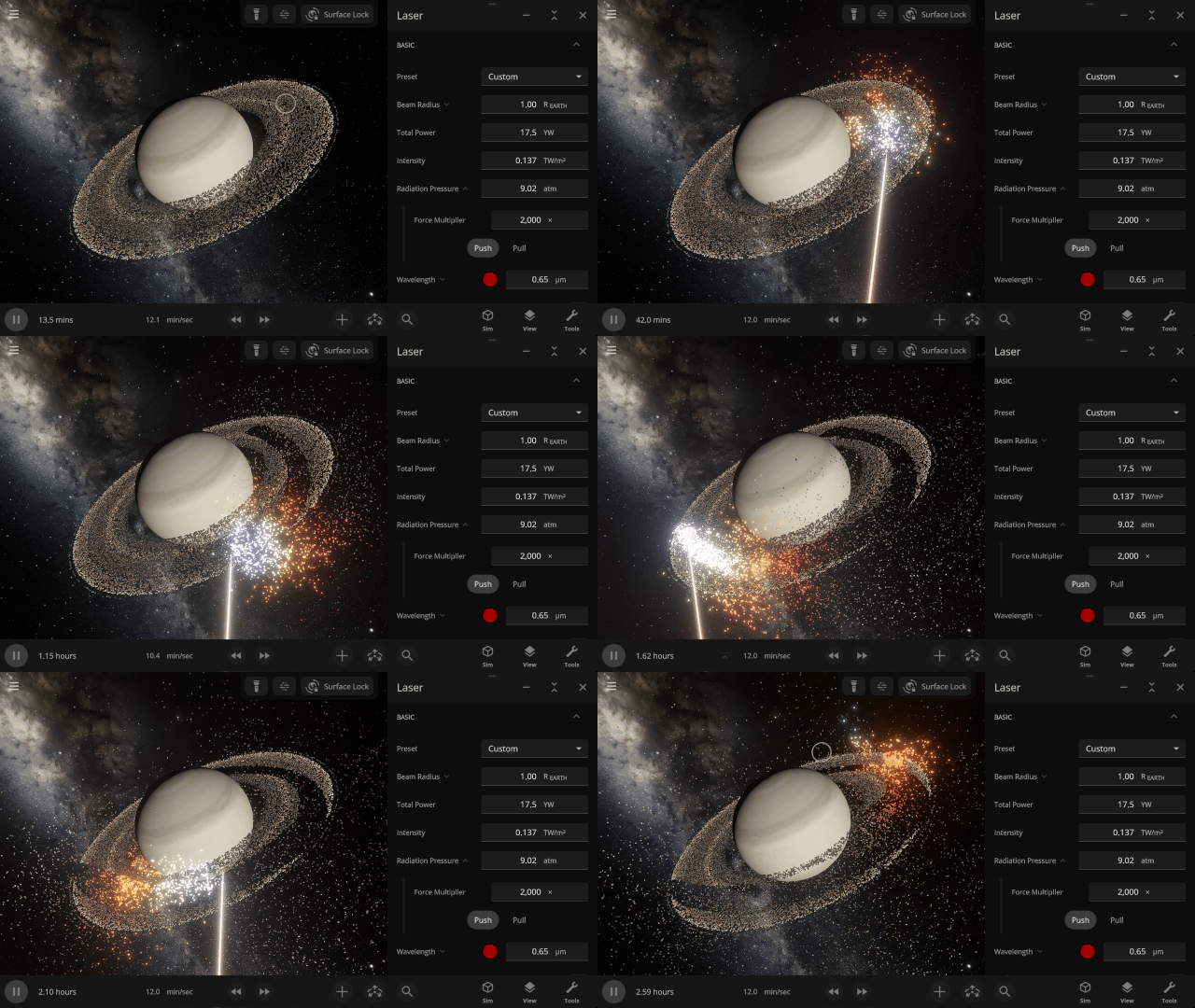
Work in Progress: Objects changing color based on their relative heating rate, heating up when blasted with the laser or crashing into each other.
Our first planned major release of 2026 is our physics architecture overhaul that will simulate meteors (atmospheric drag) and improve lasers. We’re also continuing development on life simulation, bringing Universe Sandbox to mobile devices, and other grand plans. But before we get into those projects, let’s look back at some highlights from last year.
Highlights from 2025
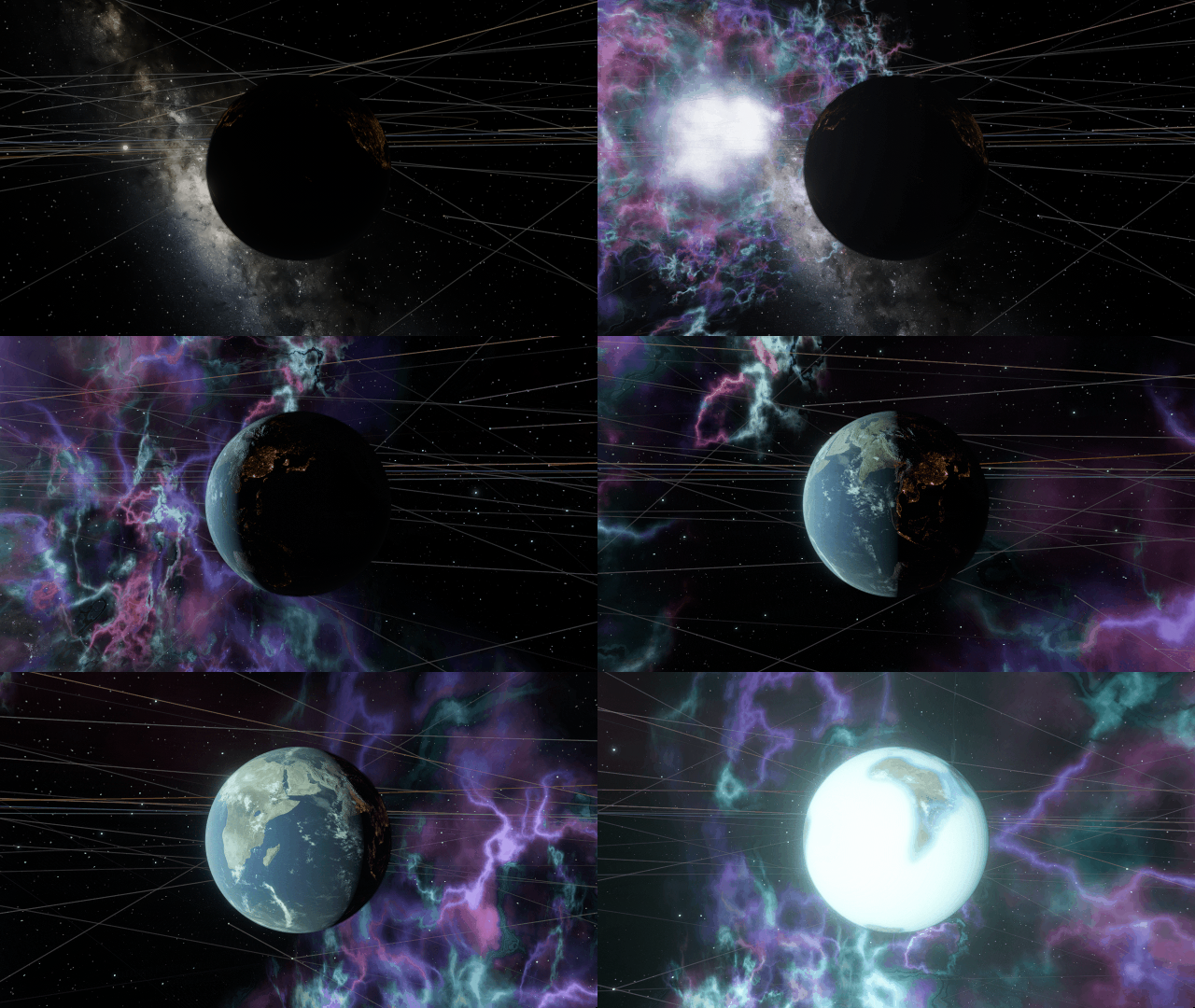
Our first big release in 2025 included a major graphics overhaul, a new dynamic user interface, and multi-object editing. We also released four other updates throughout the year, with new simulations, supernova lighting, and object descriptions. Some of our biggest accomplishments include
- Replacing our 10-year-old graphics technology with a state-of-the-art system for a more awe-inspiring and realistic universe, a project that took about 2 years. (Update 35, March 2025)
- Implementing a new interface system that automatically positions, resizes, and closes panels so you can focus on the simulation instead of managing the interface (Update 35, March 2025)
- Supernovas light up your simulation and leave behind a remnant if the exploding star is massive enough (Update 35.2, June 2025)
- Releasing a preview version of our physics architecture overhaul, including improved lasers, atmospheric drag, and more! Try it now (Update 36 Preview, December 2025)
Our major graphics overhaul and interface improvements were both major milestones from our 2024 Roadmap, and our next physics update has been a major milestone for the last few years.
What’s the Plan for 2026?
- Finish our major physics overhaul.
- Add planet-scale life simulation where vegetation and animals grow, die, get eaten, and more.
- More simulation improvements, including
- Overhauling the tech behind our surface simulation to make it more efficient.
- Updating our heating and cooling systems.
- Lay the groundwork for constructing and simulating spacecraft and megastructures with improvements to our collision simulation and detection systems.
- Bring Universe Sandbox to phones and tablets (iOS & Android).
We’re planning these projects for 2026, but additional challenges may arise that delay features, and our priorities may change.
Blast, Crash, & Smash – Physics
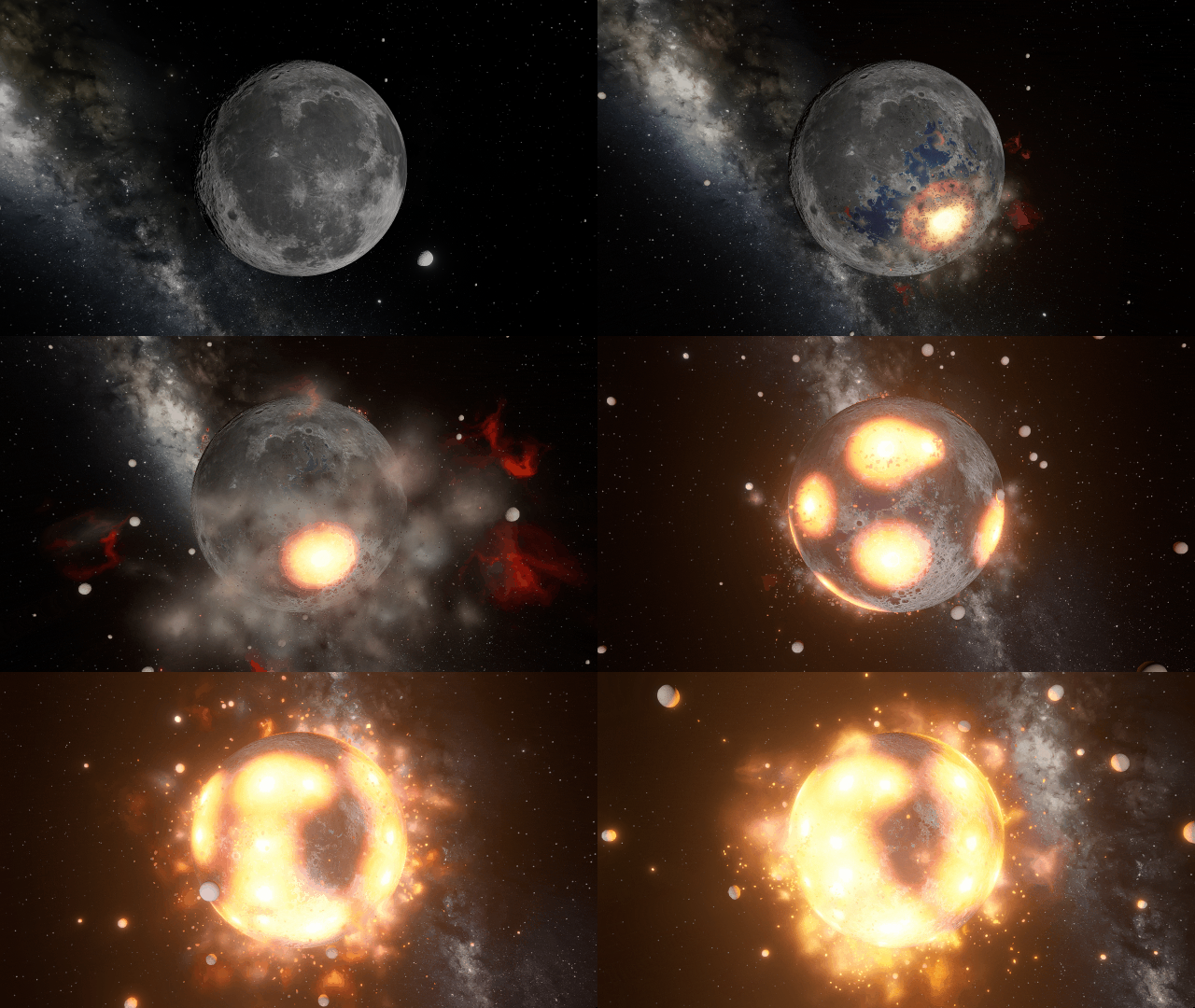
At the end of last year, we put out a preview of our major physics simulation architecture changes, including improved lasers, atmospheric drag, and simulated visual stretching and flattening of fast-rotating objects. This year, we plan to release this update and begin improving the rest of our simulation.
- Overhauling our Simulation Architecture
- We’ve been working on rewriting large portions of Universe Sandbox using the Data-Oriented Technology Stack (DOTS) from Unity, the game engine we use to build Universe Sandbox, to improve performance, make our code easier to maintain, and provide a new foundation for features such as spaceships and megastructures.
- Our next update applies the DOTS framework to our gravity, collisions, and fragmentation systems and includes
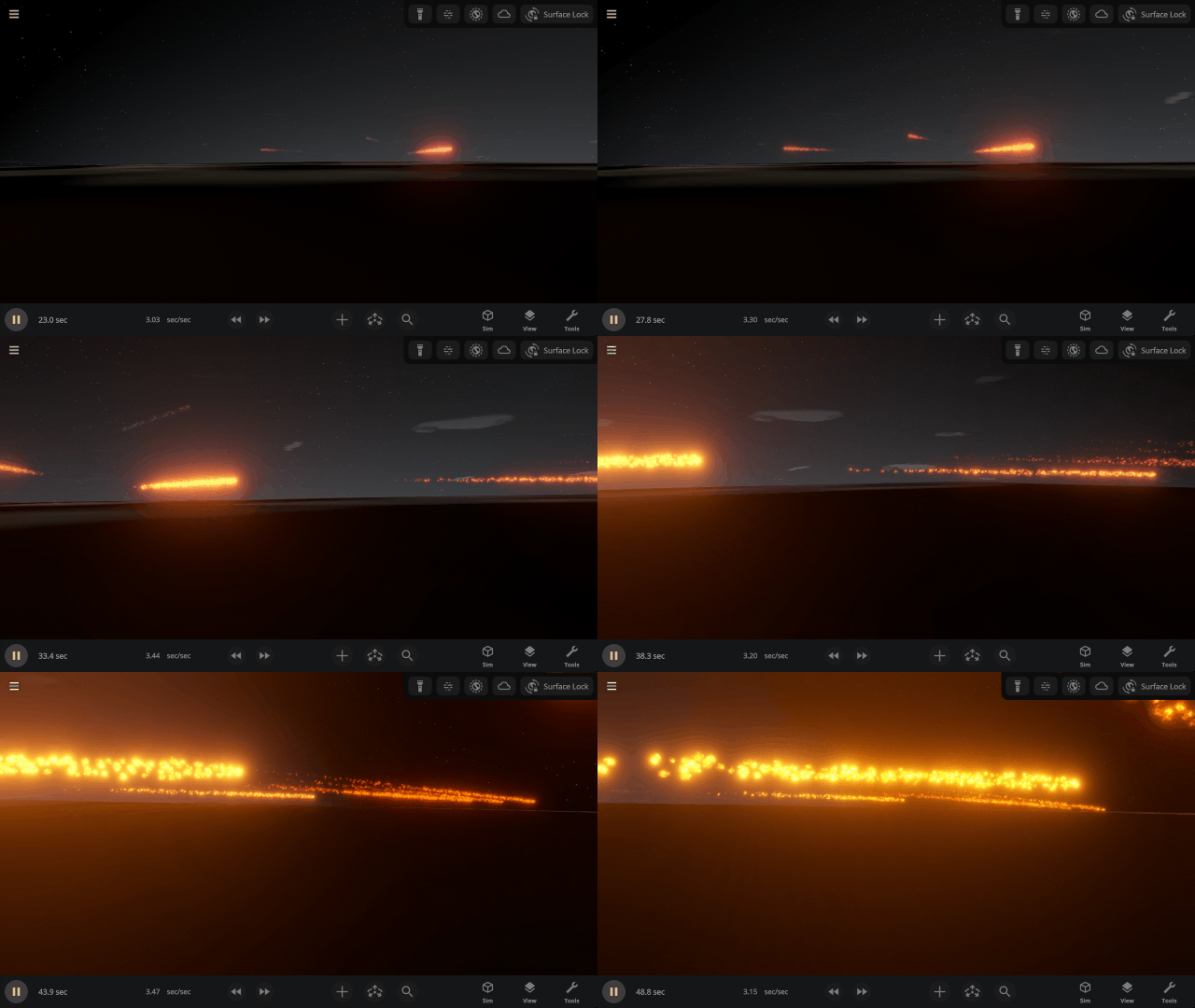
- Objects burning up as they travel through planet atmospheres with our new atmospheric drag force to simulate meteors.
- Objects burning up as they travel through planet atmospheres with our new atmospheric drag force to simulate meteors.
- We’ve been working on rewriting large portions of Universe Sandbox using the Data-Oriented Technology Stack (DOTS) from Unity, the game engine we use to build Universe Sandbox, to improve performance, make our code easier to maintain, and provide a new foundation for features such as spaceships and megastructures.
-
-
- Improving lasers to blast multiple objects at once (instead of just one object at a time) and pushing objects around by increasing light’s radiative pressure.
-
-
-
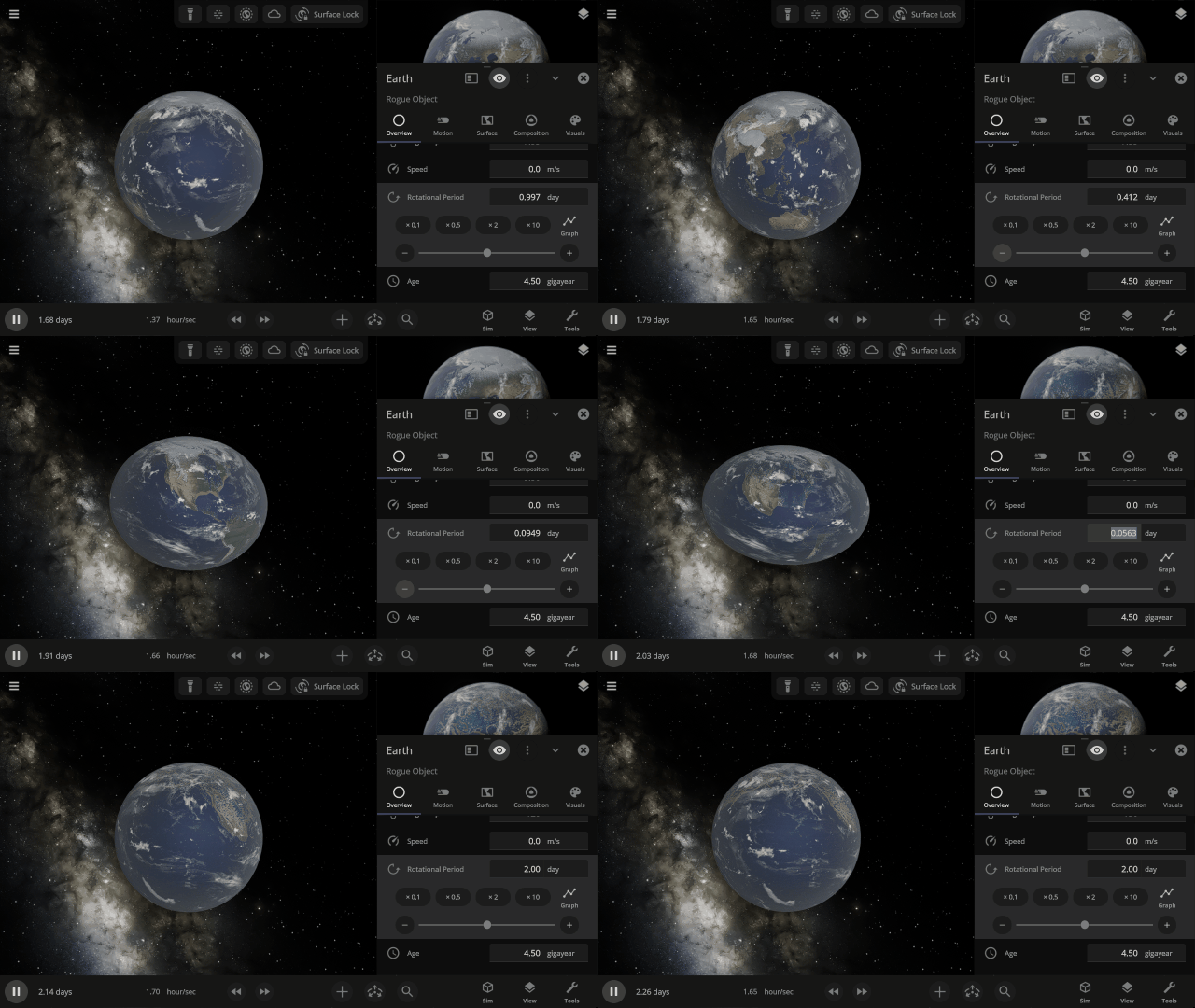
- Simulating the stretching and flattening of objects in real life due to gravity or fast rotation. However, collisions and surface simulation will continue to simulate as perfect spheres even on stretched objects until this is improved in a future update.
-
-
- Future updates will incorporate the DOTS framework into other simulation systems, including
- Surface simulation, which simulates temperature, liquid, and gas flow, and all parts of the surface.
- The graphics rendering system, to eventually enable us to smoothly simulate visual transitions between object types, such as rocky planets becoming gas giants.
- These improvements will not change our overall visuals.
- Our composition and heating systems, which manage the internal structure of objects, phase changes, and sources of heating and cooling.
- Future updates will incorporate the DOTS framework into other simulation systems, including
- Gravity Simulation Optimizations
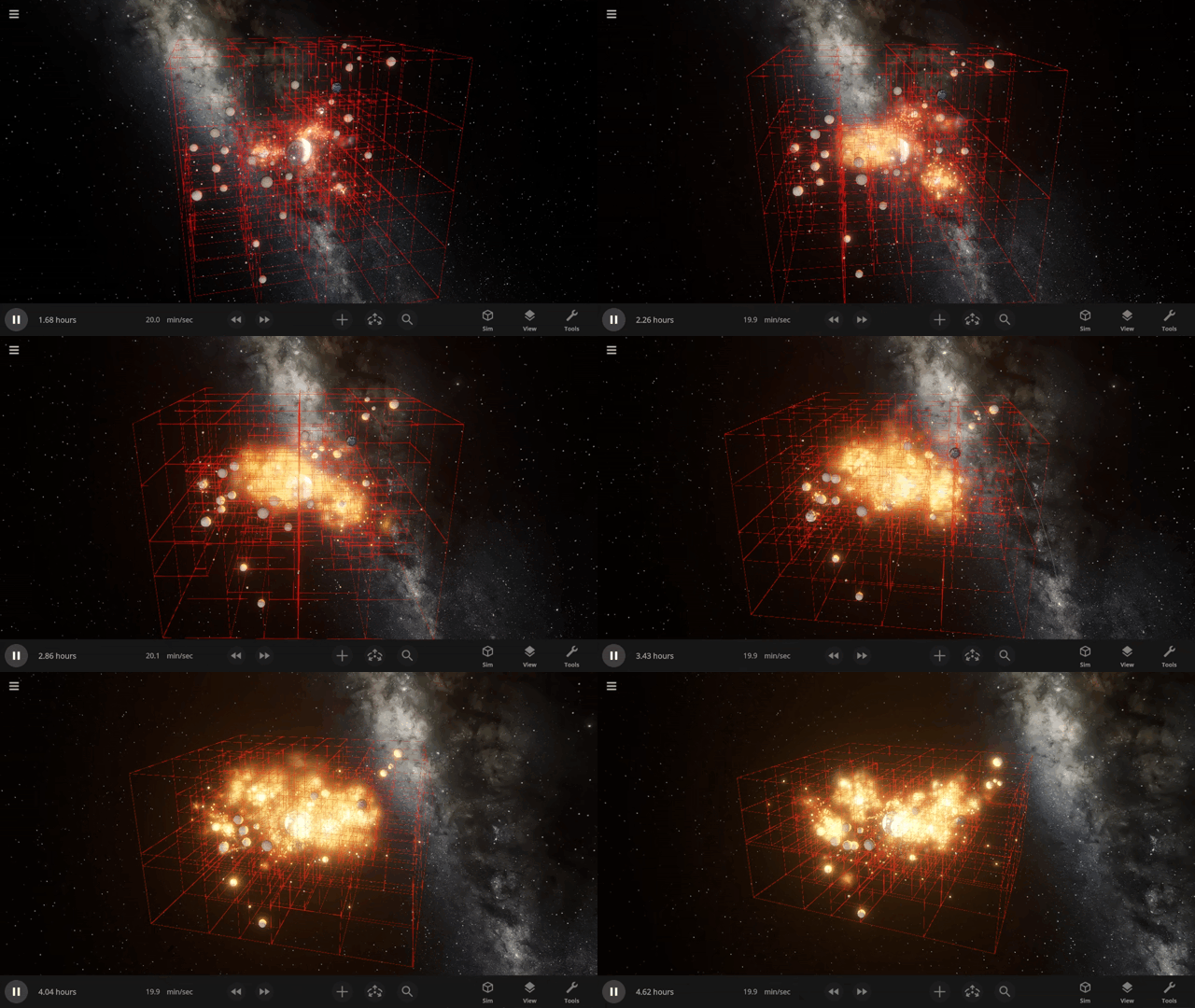
We’re looking into adding an additional method of N-body gravity simulation, called Barnes-Hut simulation, that can allow more simulated objects at the cost of slightly reduced accuracy. This will enhance our ability to simulate rock fragments and dust clouds attracting and merging to form planets & moons.
- Detailed Dynamic Collisions
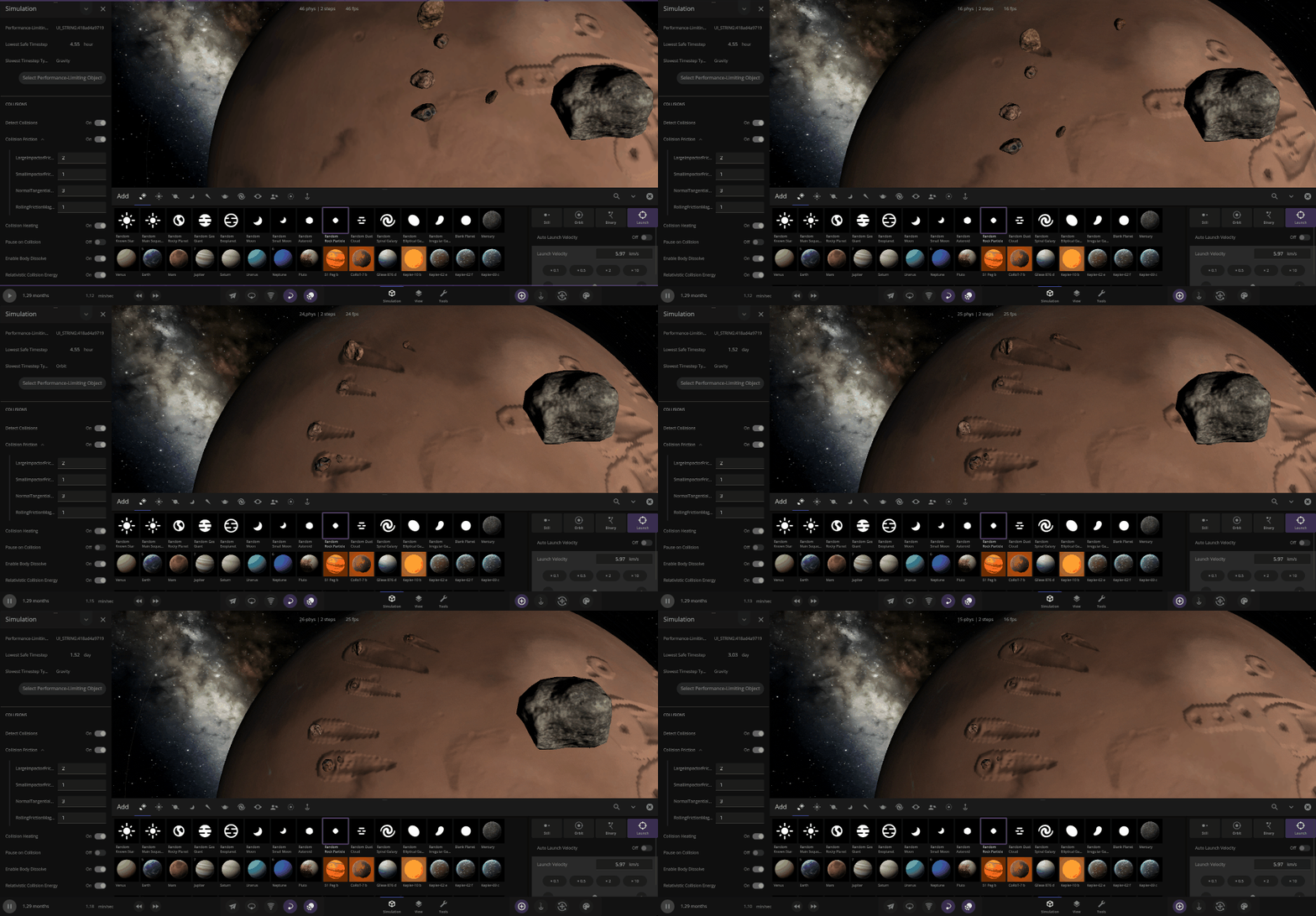
- Adding spin to fragments as they fly through space and roll across planets. Right now, fragments do not rotate when created.
- Simulating collisions of objects with their true shape (called rigid-body physics). Currently, all objects, from dice to celestial objects deformed by spin or tidal forces, are always simulated as spheres.
- Unifying celestial and non-celestial object collisions, including rigid body physics, into a single system.
It’s Alive! – Life Simulation
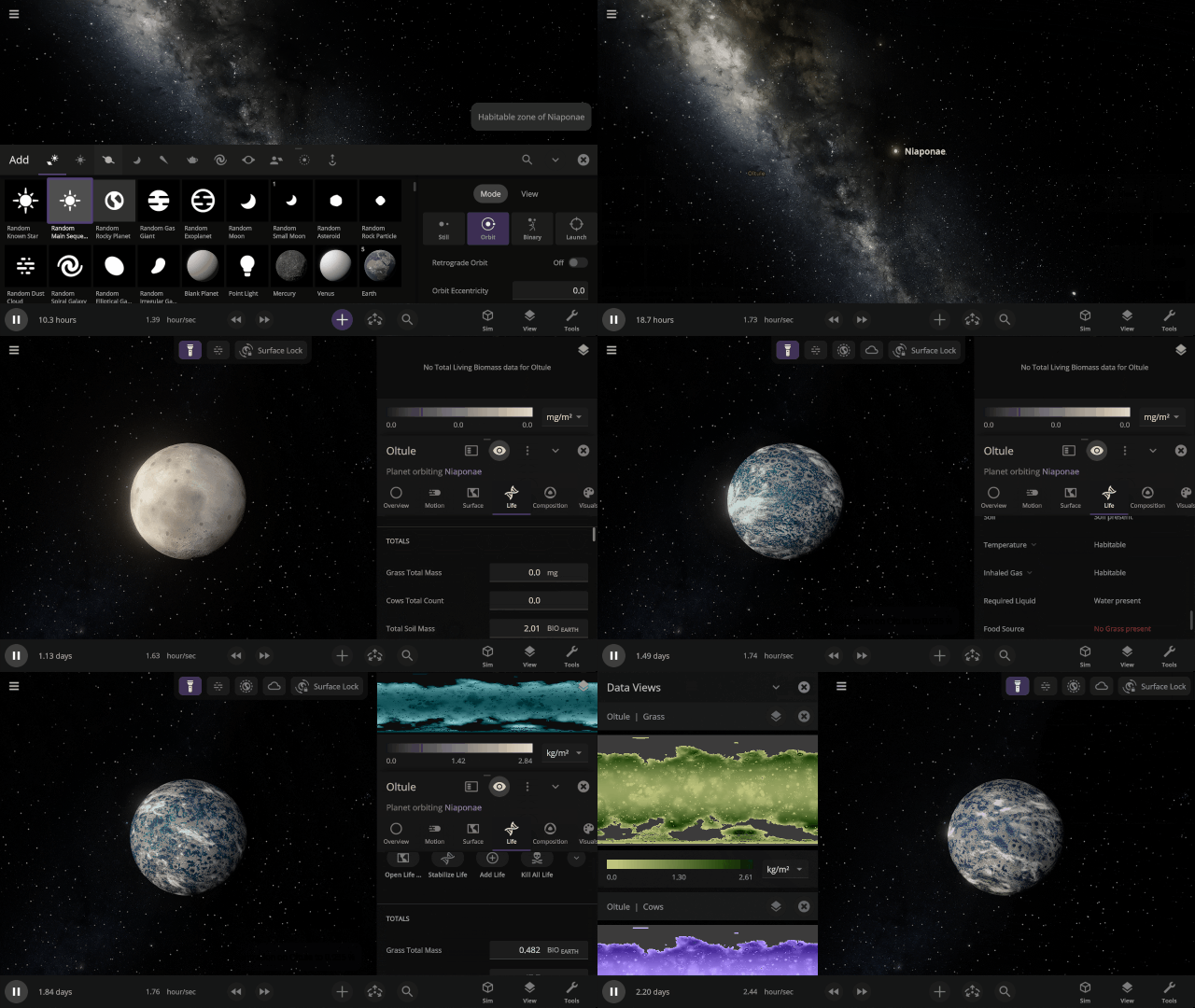
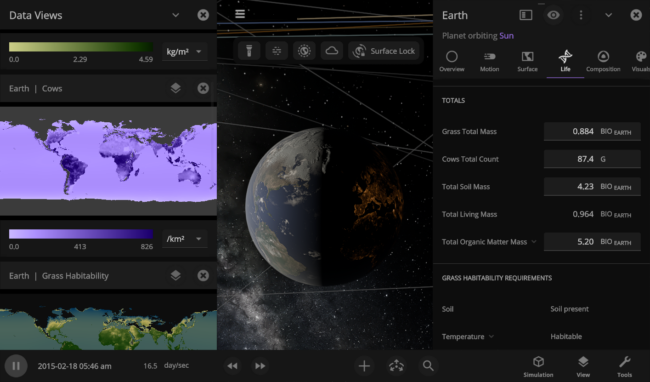
Make worlds habitable with the click of a button, create custom species, and watch populations rise and fall across dynamic planet surfaces. Simulating life is a big focus this year, and we’re making good progress.
- Growth & Death
- Vegetation will grow, spread, and die based on local surface conditions, such as surface temperature and concentrations of gases and liquids.
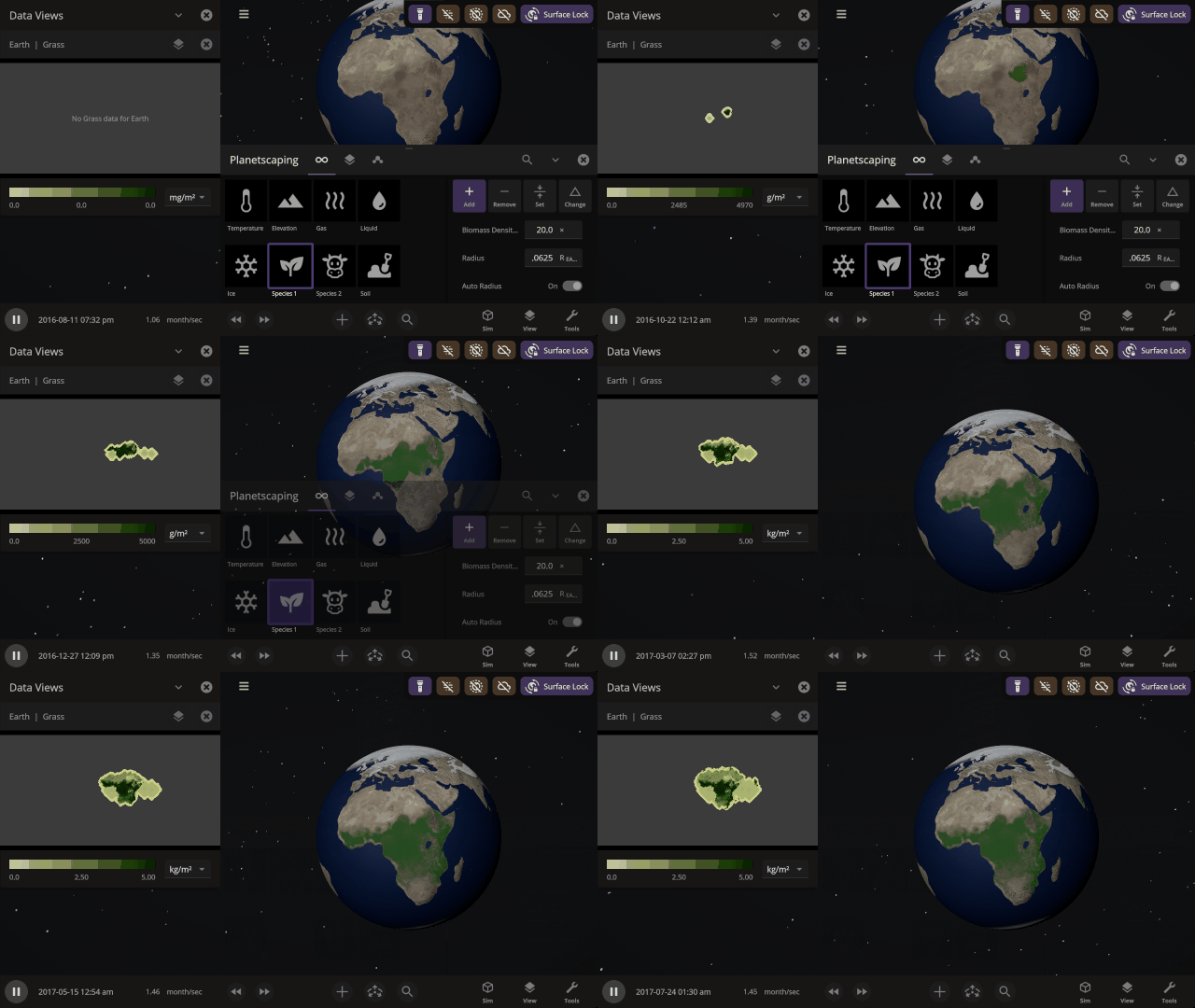
-
- Herbivores can also be simulated on planetary surfaces, and their populations depend on their food sources. If you kill all the grass the cows eat, they won’t live very long.
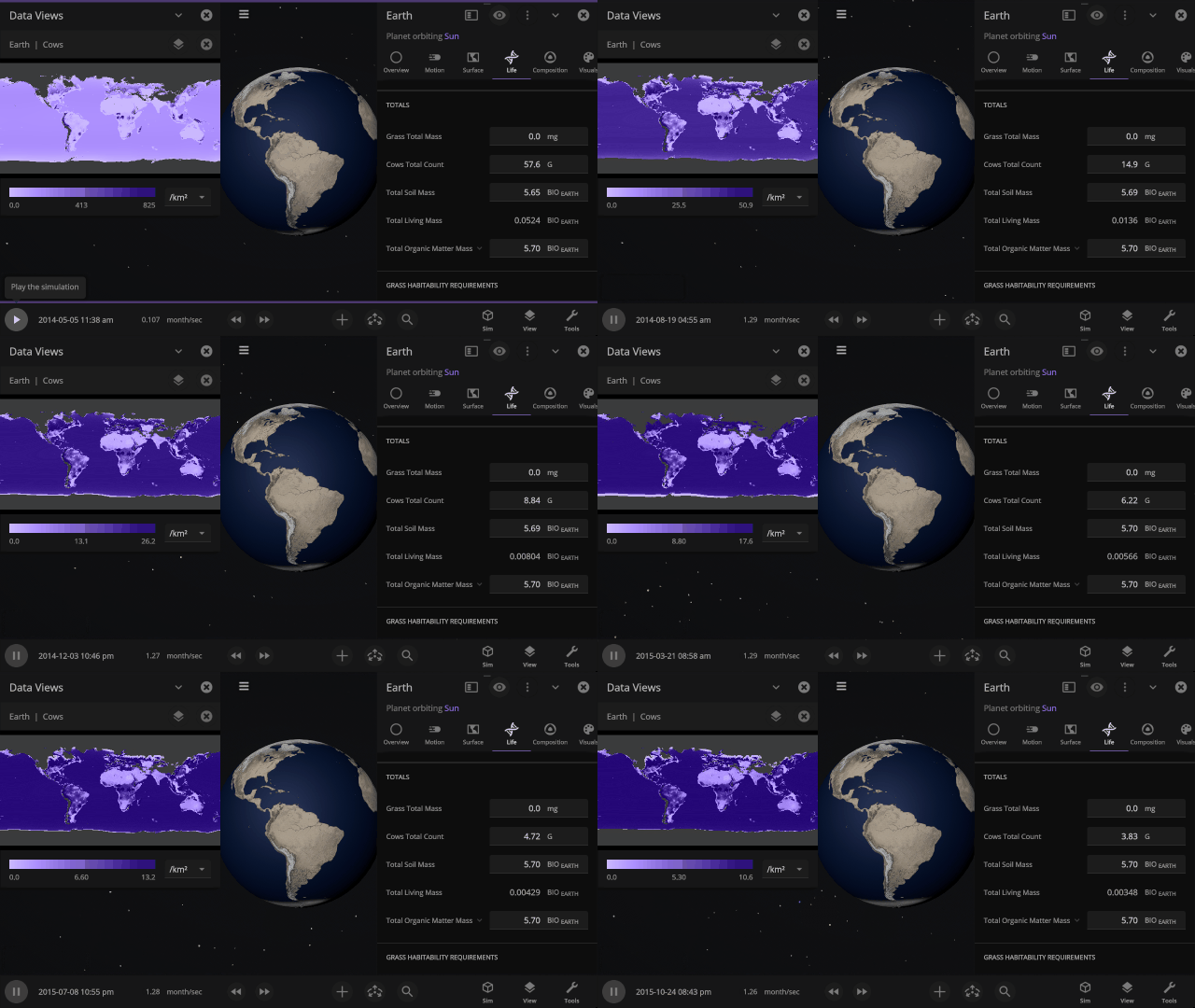
-
- Life is simulated on the same planetary scale as surface materials (like water and oxygen), so while you’ll see growth from space, you won’t see individual organisms on the surface.
- Creature Creation
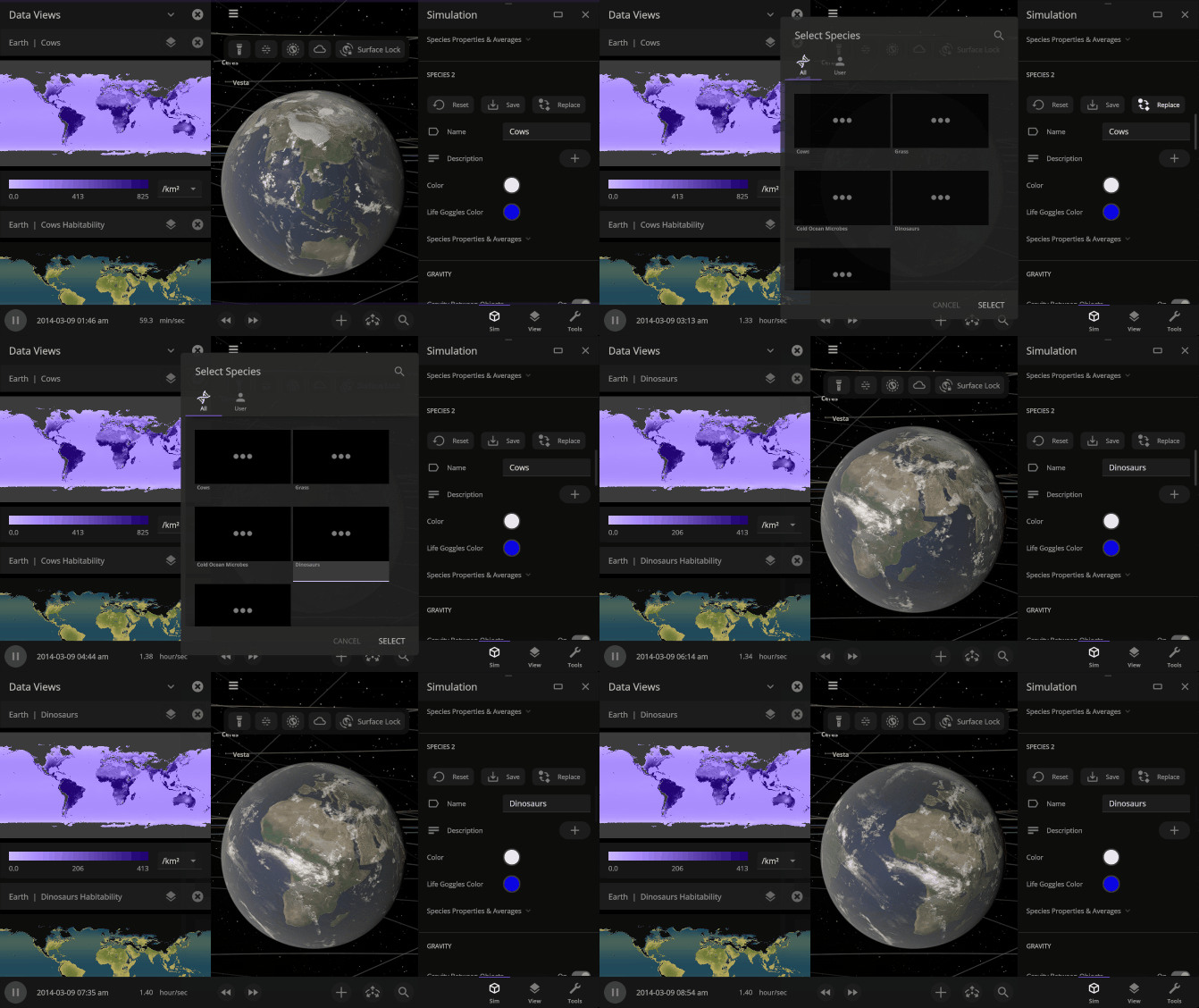
- Species will be customizable, so you can set the conditions required for any life you can imagine. Make your own custom methane-based life on Titan!
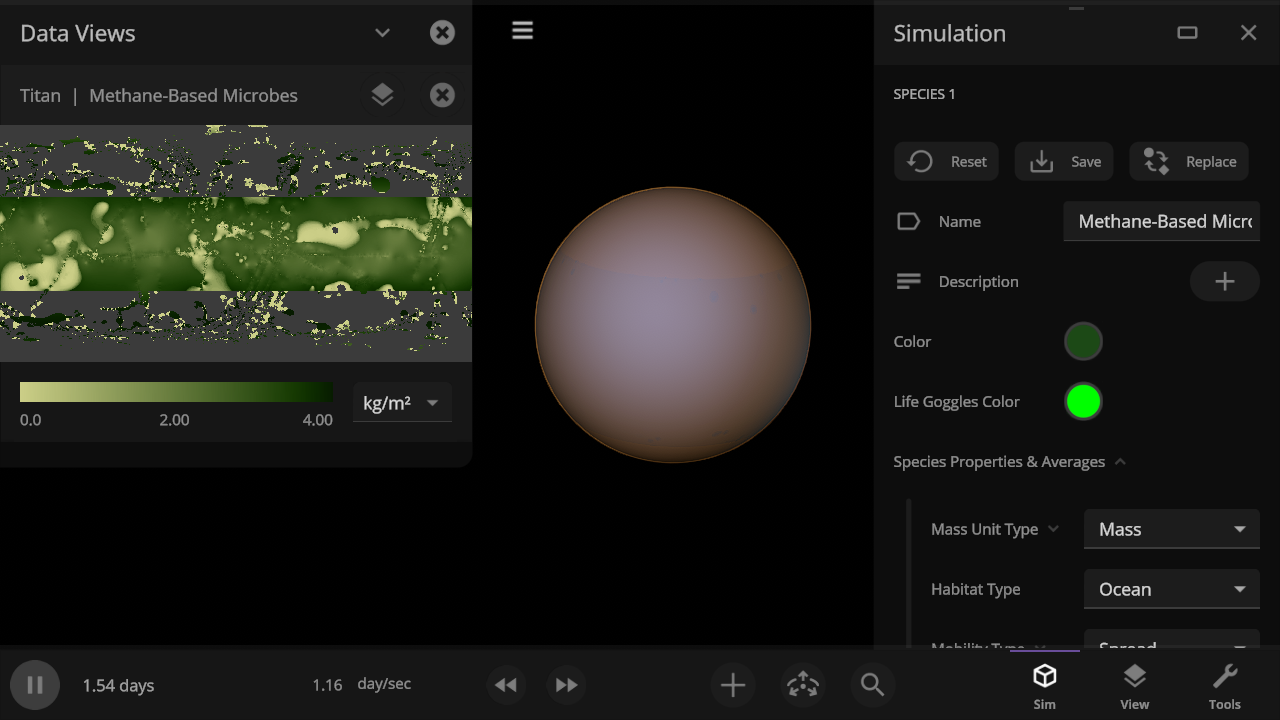
-
- In addition to preset species, like grass, cows, and dinosaurs, you’ll be able to save and share your custom species and add them to any simulation.
- Let There Be Life (and Death)
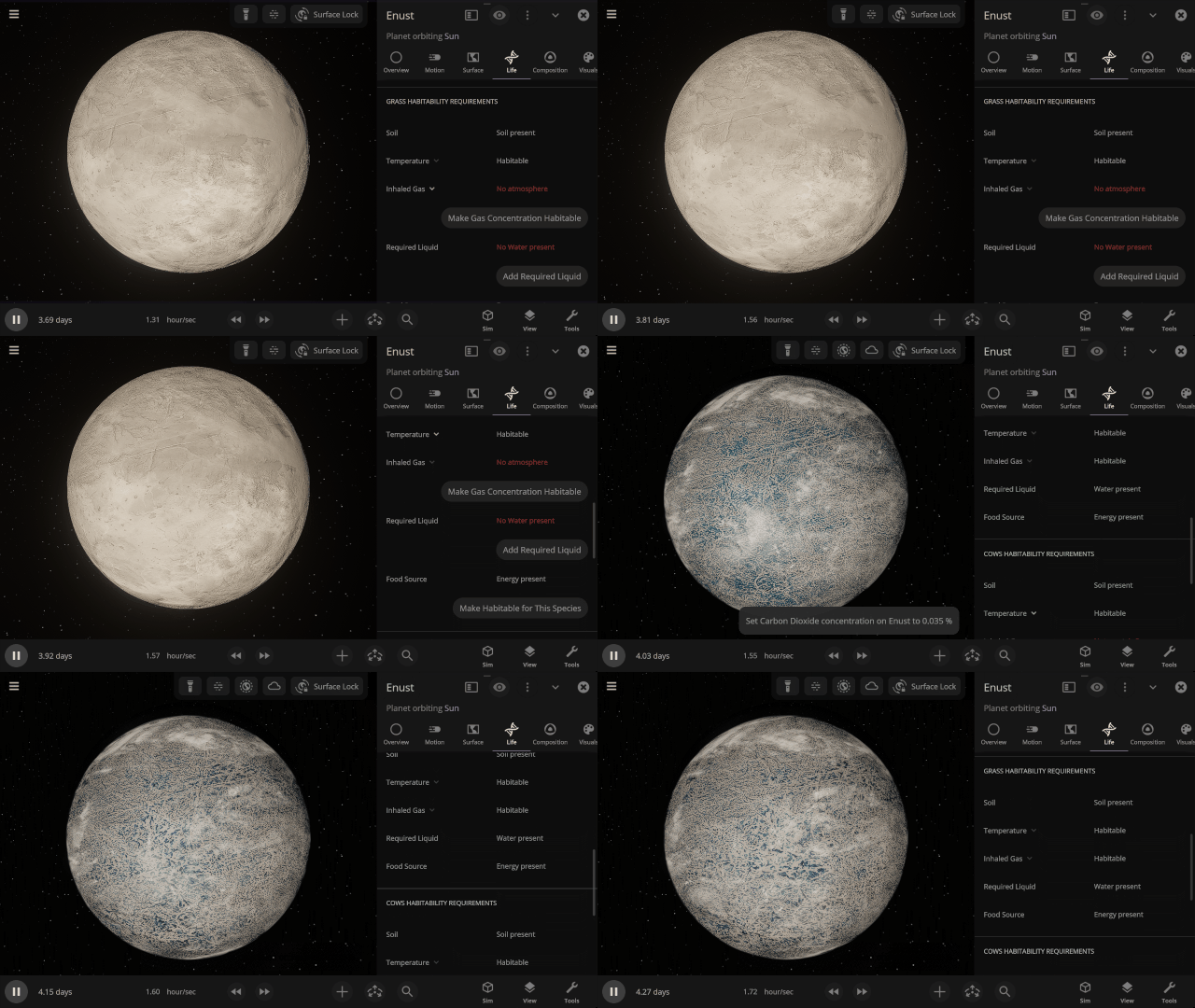
- Creating a habitable planet is hard, but we’re making it easier. You’ll be able to make any planet habitable for a specific species with the click of a button (or two).
-
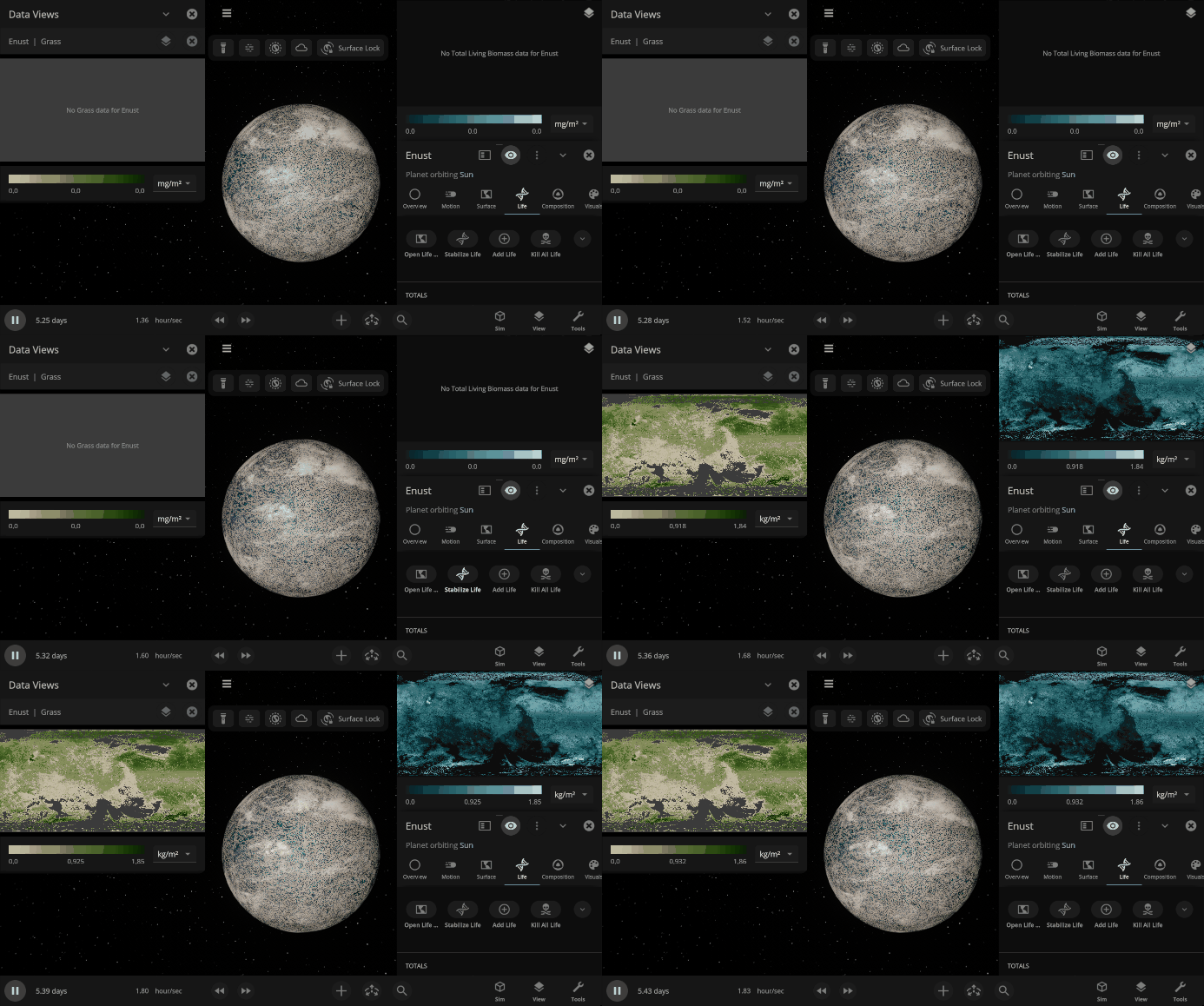
- Life can take a long time to grow and spread, but if you’re impatient, Stabilize Life will instantly populate your species on a planet based on local conditions.
-
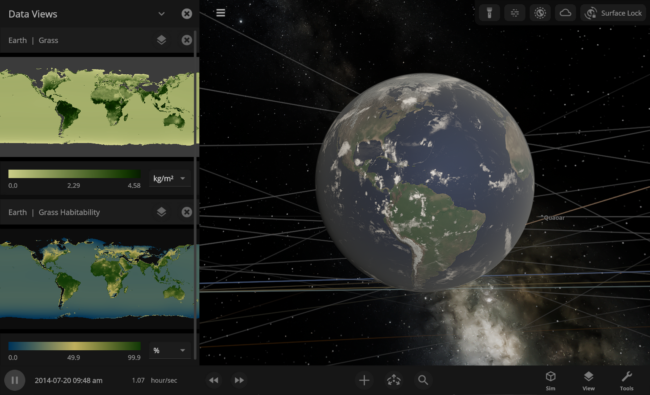
- Because life varies across the surface of an object, we’ll determine the maximum possible population of a species on each part of the surface based on local habitability conditions, rather than with the old planet-wide Life Likelihood value. More vegetation will grow in forests than in deserts, for example.
- New data views will help you monitor habitability, population, and more.
- Because life varies across the surface of an object, we’ll determine the maximum possible population of a species on each part of the surface based on local habitability conditions, rather than with the old planet-wide Life Likelihood value. More vegetation will grow in forests than in deserts, for example.
-
- You’ll even be able to see the specific population, in individual count, of each species alive on each planet.
- Future Plans
- Increase the complexity of the food chain by adding carnivores.
- Simulating two distinct species per planet instead of having only two species in the simulation. Earth could have grass and cows, while the Moon could have fungus and beetles.
Looking Good – Graphics
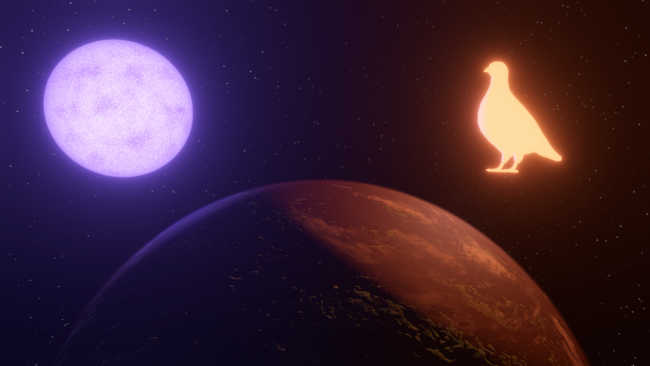
Customizing objects to emit light with any brightness and color, improving object selection to use shape conforming outlines, and implementing upscaling to improve frame rates (especially on slower computers) are all in active development.
- Your Light, Your Way
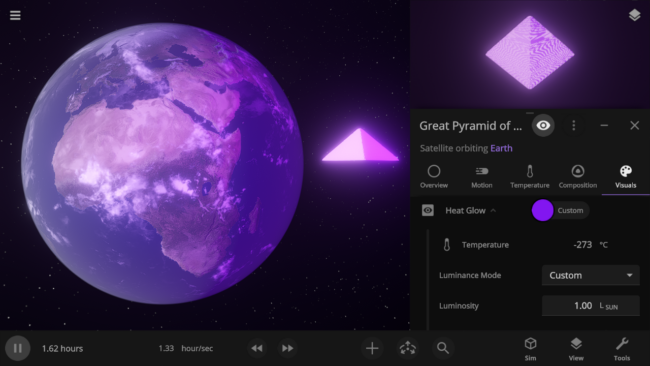
- Any object, from stars to pyramids, can be set to emit light no matter its temperature. Customize the light color and luminosity under the object’s Heat Glow, and make a whale as bright as the Sun. Previously, only hot objects could emit light.
- Check it out in the latest preview version of our physics simulation architecture changes.
- Any object, from stars to pyramids, can be set to emit light no matter its temperature. Customize the light color and luminosity under the object’s Heat Glow, and make a whale as bright as the Sun. Previously, only hot objects could emit light.
- Selecting Objects
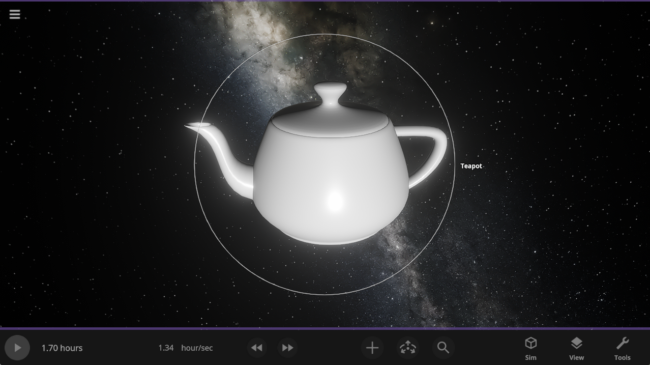
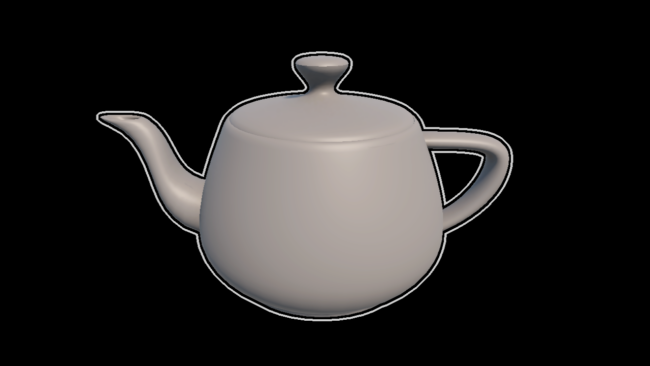
- Objects will have stylized outlines that conform to their on-screen shapes, rather than always being circles, even for human-scale objects like teapots.
- Behind the Scenes
- Adding more efficient upscaling methods (like DLSS and FSR) that resize lower-resolution images to higher resolutions will help increase performance across all platforms.
- Experimenting with different anti-aliasing methods, which smooth out jagged lines and images, will help make Universe Sandbox look even better without sacrificing performance.
A Universe on the Go – Mobile
Work in Progress: Loading the Earth & 100 Colliding Moons simulation, then watching chaos ensue on an iPhone 14 Pro.
We’re still polishing our user interface and improving performance, but we’re closer than ever to bringing Universe Sandbox to mobile devices (iOS and Android). This has been a major focus for a few years, and we’re continuing to prioritize it and the required features this year.
- Big Simulation, Little Computer
- Boosting performance across all platforms is a major mobile requirement for us. Our physics simulation architecture overhaul (currently available as a preview) will deliver necessary performance gains for both mobile devices and desktops.
- We’ve been scouring our codebase to identify and implement performance improvements, including better caching for textures and the user interface.
- Internal graphics improvements, such as new upscaling methods, will enhance performance on mobile devices.
- How to Control the Universe
- We’re continuing to improve our interface system that automatically positions, resizes, and closes panels so you can spend less time moving the interface around and more time interacting with the simulation.
- We’re continuing to improve our interface system that automatically positions, resizes, and closes panels so you can spend less time moving the interface around and more time interacting with the simulation.
- More Information
- Universe Sandbox on mobile is built from the same codebase as the desktop version and will have the same features.
- The mobile release date is still to be determined.
- We expect to release the mobile version as a one-time paid app with no ads or in-game purchases. We haven’t yet finalized pricing.
- While we want to support as many devices as possible, the minimum hardware requirements are not finalized.
- Sign up for our mobile mailing list to receive updates about mobile development
http://universesandbox.com/mobile/
Behind-the-Scenes Changes
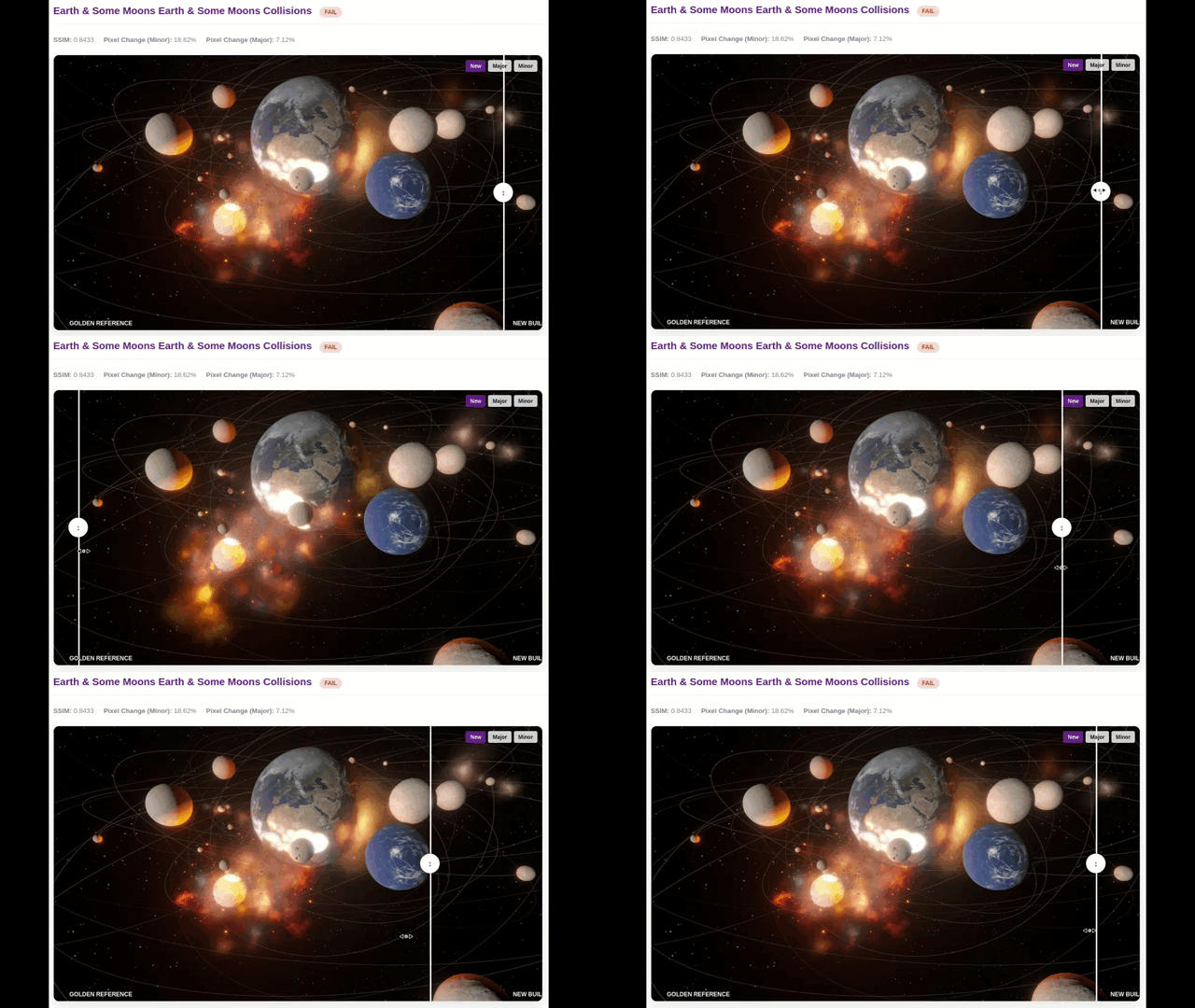
Flashy new features are always fun to share, but we’re also constantly improving our development process. These under-the-hood changes may not be obvious, but they can make a big difference over time.
- Save Files
- Simulation and object save files are now more versatile and capable in our physics simulation architecture changes preview. In the future, this will allow you to save and share custom presets (such as individual species of life).
- Simulation and object save files are now more versatile and capable in our physics simulation architecture changes preview. In the future, this will allow you to save and share custom presets (such as individual species of life).
- Testing, Testing, 1, 2, 3
- We’re continuing to improve and standardize our suite of automated testing tools for quantifying and comparing collision physics, simulation performance, and graphical changes.
- Continued improvements to the system we use to build, test, and distribute new versions of Universe Sandbox have made it even easier to release updates, patches, and preview versions. What used to take one person a few hours is now as simple as a couple of clicks.
And Beyond!
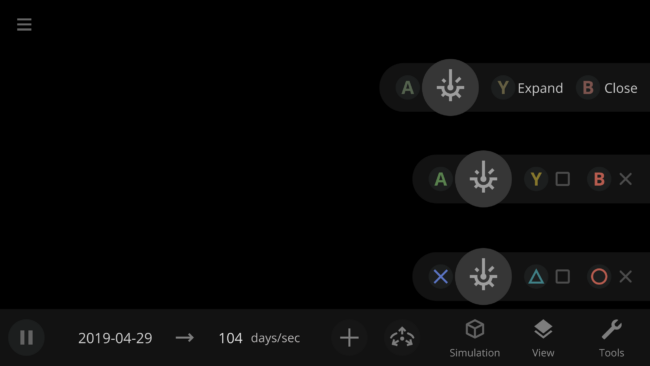
Our plans extend beyond 2026 and include adding detailed planet surfaces, simulating stellar life cycles, and adding gamepad support. Some features are in early development, while others are still in the planning phase, and we don’t yet know when they will be released.
- Spaceships & Megastructures
- From small spacecraft to Dyson spheres, we want you to be able to construct (and destroy) structures with simulated parts and physics. Adding rigid-body physics is the next major step toward making that happen.
- From small spacecraft to Dyson spheres, we want you to be able to construct (and destroy) structures with simulated parts and physics. Adding rigid-body physics is the next major step toward making that happen.
- Detailed Planet Surfaces
- Imagine flying over mountains and through canyons on planet surfaces in Universe Sandbox. We’re still experimenting with adding procedural detail and terrain to planet surfaces.
- Imagine flying over mountains and through canyons on planet surfaces in Universe Sandbox. We’re still experimenting with adding procedural detail and terrain to planet surfaces.
- Planet Customization
- Satisfy your world-building desires and create a planet using custom maps or images (like a picture of your dog).
- Satisfy your world-building desires and create a planet using custom maps or images (like a picture of your dog).
- Stellar Lifecycles
- Realistically simulating how stars burn hydrogen into helium (and heavier elements) and die violent deaths is complex, but we’re thinking about how to rebuild our star simulation so we can bring stellar evolution to Universe Sandbox.
- Realistically simulating how stars burn hydrogen into helium (and heavier elements) and die violent deaths is complex, but we’re thinking about how to rebuild our star simulation so we can bring stellar evolution to Universe Sandbox.
- Gamepad, Steam Deck, and Home Consoles
- What could be better than playing Universe Sandbox from the comfort of your couch? We want to add gamepad support so you can control your universe in more ways. This will improve our Steam Deck support and could enable support for other gamepad-based consoles in the future.
We’re excited to bring so much to Universe Sandbox this year, and we can’t wait to share it with you!